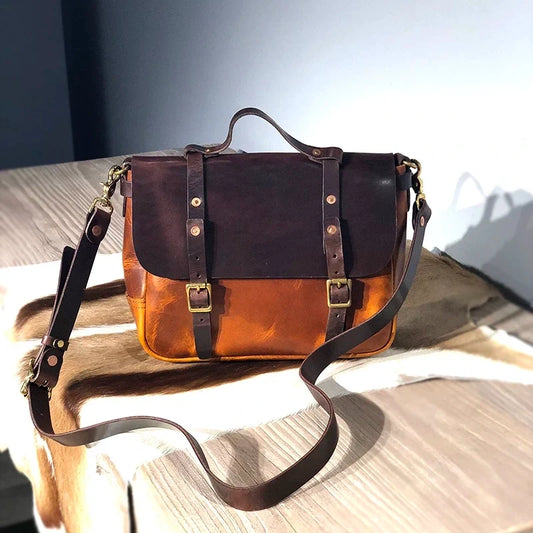

7 Mistakes to Avoid When Buying Leather Backpacks
Avoid seven common leather-backpack buying mistakes: choosing by screen-size label alone, ignoring the usable opening, treating soft leather as unlimited capacity, overlooking compartment tradeoffs, underestimating loaded weight, skipping strap and torso fit, and buying statement details without checking hardware and care.
1. Choosing by laptop label alone
A screen-size claim is only a starting point. Measure the device with its case and compare the actual compartment and padding.

Check the stated 14-inch capacity against your device dimensions and case.
2. Assuming soft leather means unlimited capacity
Soft material can conform around contents, but overpacking stresses seams, zippers and electronics. Respect the intended compartment and load.

Soft suede horsehide still needs controlled packing and two-strap support.
3. Ignoring the usable opening
A device may fit the exterior dimensions but not pass through a curved zipper or structured opening. Check the narrowest entry point.

Compare the structured opening with the stated 15-inch capacity and your real device.
4. Assuming more compartments always add capacity
Dividers improve organization but reduce flexible open volume. Decide whether separation or one larger packing space matters more.

Two large zip compartments organize work gear while dividing the usable volume.
5. Underestimating loaded weight
Large devices and travel gear become heavy quickly. Consider wide straps, back padding, anchor points and how the full load sits on your torso.

Wide straps and a padded back matter more once this travel pack is fully loaded.
6. Buying statement details without checking hardware
Studs and decorative metalwork should not distract from zippers, buckles, seams and strap anchors. Inspect all functional hardware.

Review the functional hardware behind the studded styling and exterior pockets.
7. Skipping strap, torso and riding fit
Adjust both straps over normal clothing, estimate loaded depth and make sure the pack does not restrict movement or protective gear. The largest backpack is not automatically the best fit.
Size and fit checklist
| Measure | Why |
|---|---|
| Laptop with case | Screen size alone does not define device dimensions |
| Usable opening | A device must pass through the zipper or flap |
| Loaded depth | Controls bulk and center of gravity |
| Strap range and width | Affects position and load distribution |
| Torso contact | Helps prevent the bag sitting too low or wide |
Pack for fit, not maximum volume
- Place dense items close to the back panel.
- Use both shoulder straps and adjust them evenly.
- Keep bottles and hard objects away from the laptop.
- Do not overload zippers, seams or strap anchors.
- When riding, ensure the pack does not restrict movement or protective gear.
Frequently asked questions
Will every 15-inch laptop fit a 15-inch backpack?
No. Compare the device’s actual dimensions, case and usable compartment opening.
Is a larger backpack more comfortable?
Not automatically. Torso fit, straps, load placement and total weight matter.
Does soft leather increase capacity?
It may conform around contents, but that does not justify overloading seams or electronics.
Can a leather backpack be used while riding?
Only when it does not interfere with movement, controls, visibility or protective gear.
Laptop capacities, materials, carry features and availability verified against active Motor Club Shop listings on September 13, 2026. Current product and variant details take priority.
Tags:
Related articles
Types of Leather Backpacks and When to Use Each
Sep 13 2026
How to Inspect Leather Backpacks Before Buying
Sep 13 2026


How to Choose Biker Necklaces as a Gift
Sep 13 2026


How to Choose Biker Earrings as a Gift
Sep 13 2026