Shipwreck Rally 2026: A Motorcycle Club Mass-Ride Muster Checklist
Direct answer: A motorcycle club joining a large rally ride should not treat the organizer’s general muster as its only coordination layer. The club needs a short, private-property check before departure: confirm each rider and motorcycle is ready, assign small riding pods, identify who leads and sweeps each pod, brief only the signals and stops that matter, count riders at wheels-up and again after return, and make one rule explicit—club apparel does not give anyone authority to stop or direct public traffic.
That distinction is especially useful for confirmed participants preparing for the Shipwreck Rally in Arniston, South Africa, from November 12–15, 2026. The official schedule lists an 08:30 safety briefing and muster on Saturday, followed by a 09:00 departure for a 122 km mass ride and a planned 15:00 return. The organizer currently says the rally is fully booked and limits participation to Harley-Davidson motorcycles. This independent checklist is therefore written for confirmed attendees; it is not registration advice, an official route instruction, or evidence of affiliation with the organizer, Harley-Davidson, H.O.G., or any motorcycle club shown in the original imagery.
The practical model is the 6–4–2–1 Mass-Ride Muster: six readiness checks, four defined club roles, two accountability counts, and one authority boundary. It adds a club-level coordination layer without replacing the event briefing, police direction, South African road rules, or a rider’s own judgment.
Why a mass ride needs a different checklist
Arrive Alive’s group-riding guidance distinguishes a mass ride—often 50 or more motorcycles, with no guarantee of fixed positions or distances—from a smaller group ride, which it describes as commonly involving 10–15 motorcycles in a more stable formation. That is not merely a difference in scale. In a mass ride, a rider can lose sight of a familiar club member, a gap can admit other road users, and a club’s preferred formation may have to yield to the organizer’s plan.
Official briefing first, club supplement second
The event briefing is the controlling source for the day’s route, staging procedure, departure order and organizer instructions. A club’s own muster should cover only the information the organizer cannot reasonably personalize for every attending club: who is present, who has a pillion, how your members will be divided, who carries club emergency contacts, and what your members do if separated.
Do not promise an unbroken formation
A safe plan accepts that public roads remain public. Cars may enter gaps, lights may change, and other riders may choose different speeds. Arrive Alive advises predictable riding and passing slower traffic one motorcycle at a time. A club should never pressure a member to close a gap by exceeding a safe speed or making a hurried overtake. “Ride your own ride” is not a slogan here; it is the decision rule when formation and safety diverge.
The 6 checks before wheels-up
Use the following six checks as a fast status board. The aim is not to inspect every motorcycle as a mechanic or certify anyone as safe. It is to catch an obvious “not ready” condition while there is still time to step out of the ride.
1. Rider readiness
Ask for a simple green, amber or red self-declaration. Green means ready; amber means the rider needs a few minutes, water, food, medication or a gear adjustment; red means the rider will not depart with the club. Fatigue, illness, emotional distraction and alcohol belong in this check. The Western Cape Mobility Department’s March 2026 motorcycle road-safety program emphasized responsible riding, practical skills and safety awareness. A club culture that makes “not today” acceptable is more useful than one that rewards pushing through.
2. Motorcycle readiness
Each rider remains responsible for the motorcycle. The muster check should be brief: tyres visibly serviceable, lights working, controls normal, luggage secure, nothing leaking, fuel sufficient for the organizer’s first planned stop, and no new warning light. This is a go/no-go observation, not a workshop inspection. A questionable machine should be checked by a qualified person before joining the mass ride.
3. Pod assignment
Divide the club into small pods before entering the larger field. One South African club practice documented by Arrive Alive uses pods of seven motorcycles with a leader and sweeper; treat seven as a useful example, not a universal standard. Your club may need smaller pods because of rider experience, pillions, motorcycle range or the organizer’s staging system. Keep the assignment easy to remember: color, number or a clearly visible role card.

4. Communication and signals
Brief only the signals your riders actually use and understand. Confirm whether intercoms are permitted and reliable, but do not make the ride dependent on a phone or headset connection. Every member should know the visual signal for a hazard, slowing, single file and a planned stop. If the organizer announces different signals, the organizer’s briefing takes priority.
5. Separation plan
Write down one rule for a separated rider: continue safely to the next official stop or follow the organizer’s stated recovery procedure. Do not ask the whole pod to make a sudden roadside stop, turn across traffic, or chase a rider. The sweep reports the missing rider through the agreed channel; the leader keeps the remaining pod predictable.
6. Return and parking plan
The official Shipwreck Rally page encourages attendees to park and enjoy the venue on foot, noting that most accommodation is at the venue. Use that operational cue. Decide before departure where your club will park on return, how riders will report “parked,” where keys and helmets remain, and whether anyone plans to leave the venue again. A planned transition from riding to walking reduces the temptation to move motorcycles repeatedly in a crowded social area.
The 4 club roles that prevent confusion
Four roles are enough for most club-level coordination. More titles do not necessarily create more control; they can create competing instructions. Put one name against each role and identify a backup.
Club liaison
The liaison listens to the official briefing, records changes and communicates one clean version to the club. This person does not reinterpret the route on the fly unless the organizer asks. If information conflicts, the liaison returns to the official source.
Pod lead
The pod lead sets a calm, legal pace within the organizer’s format, keeps turns predictable and does not try to “win back” lost distance. A lead is a reference point, not a traffic officer.
Pod sweep
The sweep watches the rear of the pod, notices separation and communicates status. The sweep should not block lanes, wave cars away or stop traffic. Arrive Alive specifically cautions that marshals or road captains manage traffic only when requested or authorized by the relevant authorities.
Accountability contact
This person holds the minimum necessary roster: rider name, mobile number, pod, pillion status and an emergency contact available to the club under its privacy policy. Avoid collecting identity documents, medical histories or unnecessary personal data. The role is to reconcile two counts, not to create a surveillance file.

The 2 counts that matter
Count people, not just motorcycles. A pillion is a participant. A rider who switches pods or leaves early changes the accountability picture even when the number of motorcycles looks correct.
Count one: ready to depart
Take the first count after the official briefing and immediately before your club enters the departure flow. Record who is green, who has withdrawn, the pod assignments and pillion count. A photograph of a crowded staging area is not a reliable roster.
Count two: returned and parked
Take the second count only after motorcycles are parked, engines are off and members have reported to the agreed private-property marker. Separate “not yet seen,” “returned but left again,” and “confirmed safe elsewhere.” If a rider is unaccounted for, follow the organizer’s incident process; do not send an improvised high-speed search party.
The 1 authority boundary
No club garment, lanyard, flag, title or road-captain patch grants authority to control public traffic. Club members must not block intersections, reserve lanes, direct unrelated vehicles or imitate law-enforcement signals unless the competent authority has explicitly assigned and authorized that function. The organizer’s marshals, police and lawful traffic controls take priority.
This boundary also protects the meaning of your club branding. A clearly identified liaison or sweep is useful because members know whom to approach. The same visual identifier becomes risky if the wearer uses it to imply powers they do not have.

A 72-hour preparation sequence
72 hours before the ride
- Re-read the organizer’s latest itinerary and participant communications.
- Confirm which members are registered and eligible under the event’s published rules.
- Create provisional pods based on experience, pillions and motorcycle range.
- Share the official source link rather than a screenshot that may become outdated.
- Ask riders to resolve maintenance concerns before travel.
24 hours before the ride
- Assign the four club roles and backups.
- Publish the private muster location and time without implying it is an official event checkpoint.
- Confirm the one separation rule and one return/parking marker.
- Minimize the roster to information genuinely needed for the day.
On muster morning
- Attend the official safety briefing and capture changes.
- Run the six checks without delaying the organizer’s departure flow.
- Take the first count, then release pods in the order directed by the organizer.
- Repeat the authority boundary: predictable riding, no improvised traffic control.
How to adapt the framework to club size
A club with six riders may operate as one pod. A club with 20 riders might choose three or four pods. The exact number is less important than four tests: every rider knows the pod, every pod has a lead and sweep, the whole club can be counted quickly, and the structure fits the organizer’s plan.
Do not create pods solely around friendship. Put a calm, experienced rider at each end; avoid grouping every newer rider together; and account for pillions and motorcycles with shorter fuel range. The result should reduce uncertainty, not create status.
What club gear can—and cannot—do
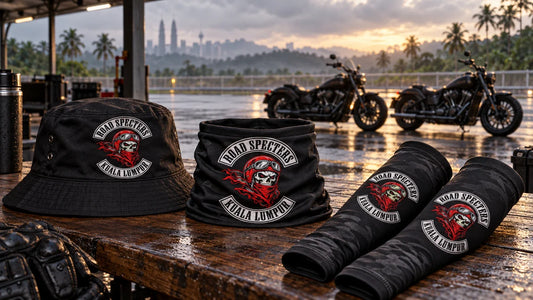
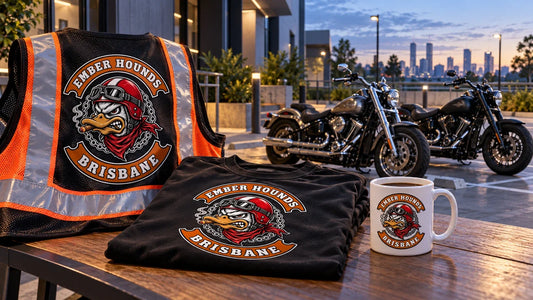
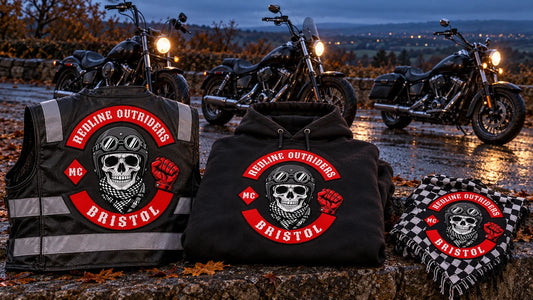
Consistent club gear can reduce search time at a crowded private muster: a colored role card helps identify a pod, a reflective vest makes the club liaison easier to find, and a flag can mark the agreed return point where the venue permits it. Those are operational benefits, not safety certifications.
Custom items should use one approved club identity, with artwork checked before production. Keep role wording simple, avoid event or manufacturer trademarks you do not own, and never print “marshal,” “official,” or similar authority language unless the relevant organization has authorized it. For this article’s original visuals, every shown item uses one consistent, client-supplied club mark; the images do not claim affiliation with Shipwreck Rally or any motorcycle manufacturer.
Frequently asked questions
What is a motorcycle club mass-ride muster?
It is a short, club-level readiness and accountability check conducted before joining a larger organized ride. It confirms riders, motorcycles, pods, roles, signals and the return plan without replacing the organizer’s official briefing.
How many riders should be in one pod?
There is no universal number. A documented South African club example uses seven motorcycles per pod, but clubs should adjust for experience, pillions, road conditions and the organizer’s directions. The pod must remain easy to identify and count.
Can a road captain stop traffic during a mass ride?
Not merely because of a club title or vest. Traffic management requires direction or authorization from the relevant authorities. Riders should obey police, lawful traffic controls and the organizer’s authorized marshals.
Should a club copy members’ identity documents for the muster?
No, not as a default. Keep only the minimum operational roster needed for accountability and emergency contact under the club’s privacy practices. Event or border-document requirements are separate and should be handled through the official process.
Is this the official Shipwreck Rally ride plan?
No. It is an independent club-operations checklist based on publicly available information checked on October 21, 2026. Confirmed participants must follow the organizer’s latest direct communications, official briefing and any lawful instructions on the day.
Sources and verification note
- Shipwreck Rally official website — dates, sold-out status, eligibility and published program; checked October 21, 2026.
- Arrive Alive: Group Rides and Motorcycle Safety — mass-ride distinction, formation and authority cautions; checked October 21, 2026.
- Arrive Alive: Motorbike Clubs and Road Safety — pre-ride meeting and pod case example; checked October 21, 2026.
- Western Cape Mobility Department: Motorcycle Road Safety Awareness Event — regional safety program context; checked October 21, 2026.
Editorial note: Event facts can change. Verify the latest organizer communications before travel. This article provides general planning information, not legal, medical, mechanical or official event advice.
Tags:
Previous
Rocky Point Rally 2026: A Motorcycle Club Border-Crossing Checklist
Next
Sawmill Rally 2026: A Motorcycle Club Wet-Weather Staging Checklist