Nelson Street Race 2027 Classes Explained: Formula, BEARS, 300SS, King & Queen of Port

Nelson Street Race 2027 is publishing a broad mix of modern, specialist and historic motorcycle classes. The organiser currently lists Formula 1–4, BEARS, Sport Bike, Super Motards, 300SS, Pre ’89, Pre ’82 and Pre ’72 (500cc+), plus King of Port and Queen of Port feature races. This guide helps spectators understand the shape of that programme without inventing engine limits, riders, grids or a timetable that the organiser has not yet released.
What matters most: the published class list is not a promise that all 11 classes will race separately. Nelson Street Race says a class needs at least 10 entries to run and that some categories may be combined—the organiser gives 300SS and Formula 3 as an example. Always read the final programme rather than assuming one class name equals one standalone race.
Nelson Street Race 2027 published classes
The official Race Info page currently names:
- Formula 1
- Formula 2
- Formula 3
- Formula 4
- BEARS
- Sport Bike
- Super Motards
- 300SS
- Pre ’89
- Pre ’82
- Pre ’72 (500cc+)
The same page names King of Port and Queen of Port as feature races. It also says the 2027 Class Rules & Regulations and proposed timetable are “coming shortly.” That boundary matters: the event-specific documents—not a generic class summary or last year’s programme—will determine the final technical definitions, eligibility and running order.

How to read the Formula 1–4 labels
For a spectator, Formula 1, Formula 2, Formula 3 and Formula 4 should first be treated as separate eligibility labels—not as a simple ranking from “best” to “least.” Technical classification can involve engine type, capacity, machine construction and the governing rules. Because Nelson’s event-specific 2027 class rules are not yet posted on the organiser’s Race Info page, this article does not assign capacities or motorcycle models to the four Formula groups.
When the final programme arrives, use its class heading and entry list together. If categories are combined on track, the programme or results may still distinguish them for classification purposes. Listen for the announcer’s explanation and do not infer that two riders sharing a race are necessarily competing for the same class outcome.
BEARS, Sport Bike, Super Motards and 300SS
BEARS
BEARS is a recognised road-racing category within Motorcycling New Zealand competition material, but its precise event eligibility belongs to the applicable national rules and Nelson supplementary regulations. Spectators can expect a distinct machine grouping; they should not decide eligibility from a brand badge alone.
Sport Bike
“Sport Bike” appears as its own category on Nelson’s published list. Until the final class rules are available, avoid converting that plain-language label into an exact capacity or modification rule. The programme is the reliable source for which entrants are classified there.
Super Motards
Super Motards bring a visibly different motorcycle silhouette and riding approach to a road course, but spectators should still use the official class label instead of guessing machine compliance from tyres, wheels or bodywork. Nelson’s final entry list will show who is actually accepted into the category.
300SS
The organiser specifically says some classes may be combined and gives “300SS and F3” as an example. That does not confirm that the combination will happen; it explains an operational possibility. If the final programme combines them, track one race while keeping the two printed class labels separate in your notes.
What Pre ’89, Pre ’82 and Pre ’72 tell spectators
The three labels signal historic-period groupings: Pre ’89, Pre ’82 and Pre ’72. The organiser adds “500cc+” to the Pre ’72 listing. These names help a viewer recognise broad eras, but they do not authorise a spectator to decide whether a particular motorcycle is period-correct. Eligibility can depend on technical details beyond appearance and is decided through the official competition process.
A useful viewing approach is to compare shapes, proportions and engineering eras without declaring a machine authentic or compliant. Record the official class beside each entry only after the programme identifies it.
Why classes may be combined
Nelson Street Race says it needs a minimum of 10 entries to run a race for a class. Combining compatible groups can keep the day moving when separate entry counts do not support independent races. It also means a pre-event article cannot truthfully publish a fixed count of races from the class list alone.
For a club class tracker, use three separate fields:
- Race label exactly as printed in the final programme.
- Classes on track when the organiser announces a combined race.
- Official result source rather than a spectator’s visual guess.
Leave all rider and result rows blank before the event. This keeps a private viewing sheet useful without making it look like an official start list or result.
King of Port and Queen of Port
The current Race Info page names King of Port and Queen of Port as feature races. The spectator page says two feature races will be last, but its wording refers to two King of Port trophies. Because those pages use different shorthand, the safest interpretation is to follow the more specific current Race Info names while checking the final programme for official titles, eligibility and order.
Do not publish a predicted field. The organiser has not yet provided the final feature-race criteria or entrant list on the pages checked for this guide. For spectators, the practical takeaway is simply to preserve time near the end of the programme and listen for the confirmed feature-race call.
What practice and sighting laps mean for a viewer
The organiser says practice and sighting laps occur before racing. They are part of the day’s track activity but should not be recorded as race results. Use them to learn the course rhythm, identify the class-board format and check where official announcements appear. Do not treat a fast practice pass as a qualifying result unless the organiser explicitly says it is.
Create a private club viewing kit
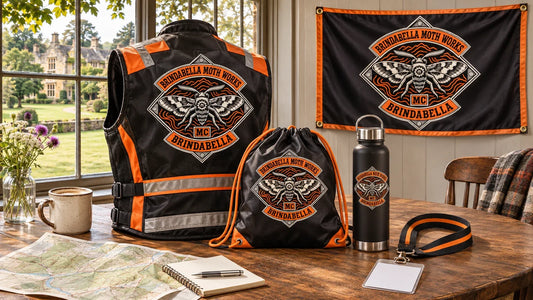
A well-designed club kit can support an all-day viewing group while staying clearly separate from event equipment. Every item below is private club merchandise: it is not Nelson Street Race merchandise, protective equipment, a marshal identifier or a pass into controlled areas.
Custom motorcycle club water bottles

A detailed multicolour emblem may suit full-colour printing on a compatible bottle, while a simplified one-colour treatment can be assessed for compatible coated or stainless surfaces. Bottle model, capacity, colour, construction, lid and decoration method must be confirmed in the proof and quotation. Concept images do not establish thermal performance or other specifications.
Design Custom Motorcycle Club Water Bottles
Custom motorcycle club arm sleeves

Full sublimation can carry detailed multicolour artwork on compatible stretch fabrics. Other construction directions may include polyester-spandex, ice-silk, compression-oriented or thermal stretch materials, but exact composition, fit, measurements and performance are confirmed for the selected style. A spectator concept should not be read as a medical, impact-protection or sun-protection guarantee.
Plan Custom Motorcycle Club Arm Sleeves
Custom motorcycle club neck gaiters

A tube-style gaiter provides a broad printable surface for a club emblem and controlled repeat pattern. Lightweight, all-season, fleece-lined, adjustable and extended-coverage directions may be available, depending on the selected construction. Confirm fabric, size, edge finish and intended wear during proofing. A custom gaiter is not a respirator, hearing protection or event credential.
Create Custom Motorcycle Club Neck Gaiters
Five rules for an accurate club class tracker
- Copy class names from the final official programme, including punctuation and combined-race wording.
- Never pre-fill riders from rumours, old entries or social comments.
- Keep practice and sighting laps separate from races.
- Do not split a combined on-track race into invented separate running times.
- Label all club notes “unofficial” and defer to organiser results.
Frequently asked questions
How many classes are listed for Nelson Street Race 2027?
The organiser currently lists 11: Formula 1–4, BEARS, Sport Bike, Super Motards, 300SS, Pre ’89, Pre ’82 and Pre ’72 (500cc+).
Will every class race separately?
Not necessarily. The organiser requires at least 10 entries to run a class race and says some classes may be combined, giving 300SS and Formula 3 as an example.
What are the feature races called?
The current Race Info page names King of Port and Queen of Port. Check the final programme for confirmed eligibility, order and official wording.
Has the full 2027 timetable been published?
Not on the official Race Info page checked on 16 November 2026; the proposed timetable and 2027 class rules were still marked “coming shortly.”
Primary sources
Class and feature-race information was checked against the official Nelson Street Race Race Info page and official spectator information. The governing context was checked against the Motorcycling New Zealand Nelson event archive, the Motorcycling New Zealand road-race chapter and its Basic Rules & Flags guidance. Recheck the organiser’s final programme and supplementary regulations before the event.
Tags:
Previous
Nelson Street Race 2027: Tickets, Times, Parking, Road Closures & Club Guide
Next
Touratech Rally West 2027 Demo Rides & Vendor Village: Club Buying Plan
Related articles

ABR Festival 2027 Test Rides & Trail Pass Guide
Nov 17 2026