
12 Types of Custom Patches: Materials and Best Uses
Quick answer: The best custom-patch type depends on artwork detail, texture, flexibility, environment, attachment method and budget. Embroidered patches suit dimensional thread texture; woven and printed options carry finer detail; PVC, leather, chenille and metal serve different construction needs.
At a glance

How to choose a patch construction

Start with the smallest important detail, the surface where the patch will be used and how it must attach. Ask the supplier for current limits and samples; construction names do not guarantee identical results across factories.
12 common patch types

| Type | Best suited to | Check before ordering |
|---|---|---|
| Embroidered | Bold shapes and raised thread texture | Small lettering and stitch density |
| Woven | Fine lines and compact artwork | Edge options and intended durability |
| Printed fabric | Gradients, photographs and dense color | Colorfastness and abrasion expectations |
| PVC | Flexible relief and wet environments | Thickness, temperature range and backing |
| Chenille | Large varsity-style forms | Minimum stroke size and bulky edges |
| Leather | Natural material and engraved or embossed detail | Leather type, finish and weather care |
| Faux leather | Consistent color and laser-marked detail | Heat and abrasion performance |
| Metal badge | Rigid, dimensional presentation | Weight, pins, edges and corrosion resistance |
| Sublimated | Full-color polyester applications | Fabric compatibility and edge finish |
| Reflective | Added low-light visibility accents | Do not treat it as certified safety equipment |
| Glow material | Decorative after-dark effect | Charge time, duration and wash care |
| Combination | Projects needing two compatible effects | Bulk, cost and production repeatability |
Compare edge and backing choices
A merrowed edge is common on simple shapes; a heat-cut or laser-cut edge can follow more complex outlines. Sew-on, hook-and-loop, adhesive and heat-applied backings serve different uses. Confirm that the garment or item can accept the chosen attachment and follow the supplier's current instructions.
Protect club identity
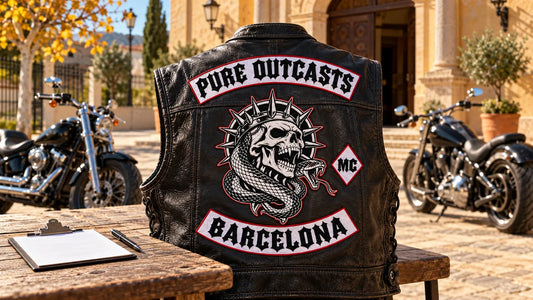
Use the approved artwork file and record who authorized it. Do not invent rockers, chapter names, dates or status symbols. Merchandise does not confer membership, rank or permission to display an organization's marks.
Approve a physical sample
Review the patch at actual size. Check lettering, color references, edge shape, reverse side, attachment, loose threads, sharp areas and consistency with the approved proof. Keep the signed sample and revision record for reorders.
Frequently asked questions
Which patch type shows the most detail?
Woven and printed constructions often reproduce finer detail than standard embroidery, but artwork, size and supplier capability still control the result.
Can any patch be ironed onto a jacket?
No. The patch needs a compatible heat-applied backing and the jacket material must tolerate the required temperature and pressure.
Tags:
Previous
How to Use Custom Patches to Promote Your Business
Next
All You Should Know About Thread Colors for Custom Embroidered Patches