
Will the Wallet Chain Clasp Fit? An Eyelet and Clip Checklist
Quick answer: Wallet chain clasp eyelet compatibility must be checked on both ends of the intended setup. Measure the wallet eyelet opening and clasp gate separately, test the actual clasp through that eyelet, then check the pocket clip or belt-loop attachment as a second fitting. A clasp that opens wide enough may still have a body too large to pass through a small eyelet.
Do not select a chain from appearance alone. The current supplier must confirm available clasp and attachment dimensions for the actual design. Use the Biker Wallet and Pants Chains buying guide for the complete order workflow, and review the current collection at Biker Pants Chains.
Record three compatibility checks
- Eyelet opening: capture the clear inside opening of the intended wallet hardware.
- Clasp gate and body: record how far the gate opens and whether the clasp body can pass through the eyelet.
- Belt-side fitting: measure the intended belt loop, pocket edge or clip location separately.
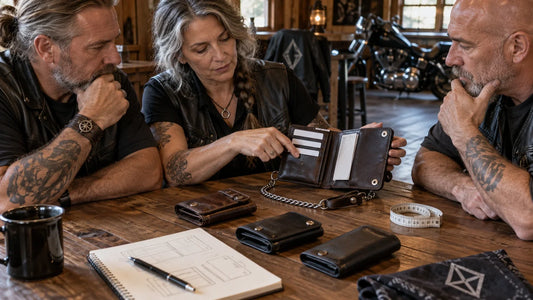
State units on every measurement and include a close, well-lit photo with a scale reference. If the supplier provides a template or specific measuring method, follow it. Leave any unavailable clasp dimension as an open question rather than inferring it from a product photograph.

Test the actual wallet-side clasp
Open the actual clasp and pass it through the intended eyelet without forcing or deforming either part. Close the gate and confirm that it moves freely. Check for an eyelet shape that narrows at one point or a clasp shoulder that catches even though the gate clears. Record the exact sample or component ID used for the test.

Check the belt or pocket side separately
The second end may use different hardware and a different opening motion. Test the actual pocket clip on the intended pocket edge, or the actual clasp on the selected belt loop. Consider belt-loop thickness as well as width. Do not assume that success at the wallet eyelet proves success at the other end.

Reject assumptions before approving the sample
Reject a proof or inquiry that says only “large clasp,” omits the eyelet, or treats a photo as proof of fit. Ask for actual eyelet and clasp dimensions, attachment photographs and a physical sample when available. A decorative wallet chain should not be described or relied on as a safety tether, and this fit check does not establish load-bearing performance.
Save the compatibility record
Store the wallet model or sample ID, eyelet opening, clasp gate opening, clasp-body clearance, belt-loop or pocket-clip dimensions, photos of both successful fittings, artwork revision, approver and date. If members use different wallets, list the approved compatible variants rather than assuming one result covers the whole roster.
Frequently asked questions
Is clasp-gate opening the only dimension that matters?
No. The clasp body or shoulder must also pass through and sit correctly in the eyelet. Test the actual parts.
Can a product photo confirm eyelet fit?
No. Perspective and scale are unreliable. Use supplier-confirmed dimensions and an actual sample test.
Should the pocket clip be tested separately?
Yes. A pocket edge and belt loop have different thickness and geometry from a wallet eyelet.
Does passing this checklist make the chain a safety tether?
No. This checklist covers physical attachment compatibility for an accessory. It makes no load-bearing or safety guarantee.
Ready for a fitting review? Explore Biker Pants Chains. Send your authorized artwork, quantities and completed measurement or sample checklist to request a design and quote review for biker pants chains.
Tags:
Previous
Biker Wallet and Pants Chains: Buying Guide for Club Organizers
Next
Biker Wallet and Pants Chains: Buying Guide for Club Organizers
Related articles
How to Prepare a Club Decal for a Curved Surface
Sep 17 2026