

How to Clean and Care for Biker Earrings
Clean sterling-silver biker earrings by handling them with clean, dry hands and polishing them gently with a soft silver cloth. Keep them dry when not in use, inspect the closure before wearing, and store each piece separately. Do not assume that household cleaner, abrasive paste, soaking or machine polishing is safe for every finish, stone, recess or attached component.
Confirm the material and construction first
Read the exact product page and selected variant before cleaning. Sterling silver, plated metal, stones, painted details and deliberately darkened recesses can require different care. This guide focuses on the six active sterling-silver listings shown below, whose published care direction is to keep them dry and polish gently with a soft silver cloth.

This sterling-silver clip-on design should be kept dry and polished gently with a soft silver cloth. Inspect the clip and contact surfaces at the same time.
Use the least aggressive routine
- Remove the earring and work over a clean, padded surface.
- Check for loose parts, bent posts, damaged hinges or unstable stones before polishing.
- Use a clean soft silver cloth with light pressure.
- Support raised motifs from behind instead of bending them.
- Stop if color, plating or an intentional dark finish begins to change.
A polishing cloth is for surface care, not structural repair. Do not force a tight hinge or reshape a post while cleaning.

For this hoop earring, polish the sterling-silver surface gently and check that the hoop closure aligns and engages without being forced.
Keep moisture and chemicals away
The featured listings direct owners to keep the earrings dry when not in use. Remove them before showering, swimming, applying hair products or using household cleaners. Dry hands before handling and never store a damp earring in a sealed pouch.
Perfume, lotion, sanitizer, hairspray and cleaning chemicals can contact metal and decorative finishes. Apply personal-care products first, let them dry, and put earrings on last.

The cross clip-on listing uses the same conservative care direction: keep dry and polish gently with a soft silver cloth.
Protect darkened detail and high relief
Many biker motifs use recessed texture or tonal contrast. Do not try to make every dark recess bright; the contrast may be intentional. Fold the cloth around a fingertip and polish accessible raised surfaces without digging aggressively into carved areas.
Avoid abrasive paste, stiff brushes and sharp tools. If residue cannot be removed safely with the product-approved routine, ask a qualified jeweler.

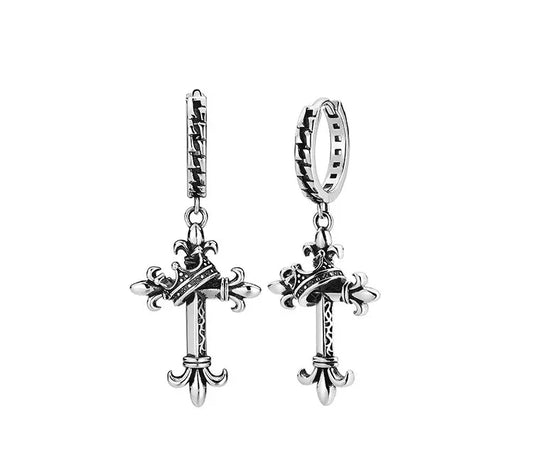
This fleur-de-lis crown cross drop earring combines raised detail and hanging movement, so support the design while polishing and avoid pulling the joints.
Inspect closures, posts and moving parts
After polishing, inspect the wearing system in bright light. Stud posts should look straight, hoop hinges should move smoothly, and clip-on contact areas should be clean and aligned. Do not wear an earring with a cracked joint, loose component or unreliable closure.
Cleanliness does not correct a mechanical defect. A qualified jeweler should assess solder joints, loose stones, distorted posts and damaged hinges.

The sculpted Pixiu hoop needs gentle surface polishing plus a closure check; avoid pulling the motif while opening or closing the hoop.
Store earrings separately
- Make sure each piece is fully dry.
- Close hoops and secure backings so parts are not lost.
- Use separate soft compartments or pouches to reduce scratching and tangling.
- Keep heavy jewelry from pressing on posts, clips and drop joints.
- Store away from humidity, direct sunlight and household chemicals.
- Keep pairs together and label single-versus-pair purchases clearly.

A close-fitting Pixiu stud should be stored with its backing secured and protected from pressure that could bend the post.
Care checklist by earring type
| Type | Extra inspection |
|---|---|
| Stud | Post straightness, backing fit and face attachment |
| Hoop | Hinge movement, alignment and latch engagement |
| Drop | Jump rings, articulation and hanging joints |
| Clip-on | Clip pressure, alignment and contact surface |
| High relief | Raised edges, recessed finish and snag points |
When to stop cleaning
Stop and seek professional advice if you see a loose stone, cracked joint, bent post, failing hinge, peeling finish, unexplained color transfer or a part that moves when it should not. Also stop wearing any earring that causes persistent redness, swelling, pain or discharge and seek appropriate medical advice.
Frequently asked questions
Can I use toothpaste on sterling-silver earrings?
Do not assume it is safe. Abrasive pastes can alter polished surfaces and darkened detail; follow the product’s stated soft-cloth routine.
Can I soak biker earrings?
Not by default. The featured listings say to keep them dry when not in use, and soaking can affect attached components or finishes.
Should every dark recess be polished bright?
No. Dark contrast may be intentional, especially in sculpted biker motifs.
How should I store a pair?
Fully dry, separated from harder jewelry, with closures and backings secured.
When is cleaning not enough?
Loose parts, bent posts, cracked joints and faulty closures require inspection or repair rather than more polishing.
Materials, care directions and availability verified against active Motor Club Shop listings on September 12, 2026. Current product instructions take priority.
Etiquetas:
Anterior
Motorcycle Lighting Installation: Parts and Tools Checklist
Siguiente
Leather Cuff or Metal-Link Club Bracelet? A Design Comparison
Artículos relacionados

How to Inspect and Maintain Motorcycle Lighting
Sep 13 2026


Full-Grain vs Top-Grain Leather Crossbody Bags
Sep 13 2026