Rotorua Motocross Finale 2027: Starts, Flags, Points & Tie-Breaks

Rotorua Motocross Finale 2027: Starts, Flags, Points and Tie-Breaks Explained
Quick answer: the fourth and final round of the 2027 Yamaha New Zealand Senior Motocross Championship is approved for Saturday, 27 February 2027 at Rotorua MCC MX Track, 1455 State Highway 30, Horohoro, under MNZ permit 22064. For spectators trying to understand what happens on track, the current MNZ rules establish an independent backward-falling gate, a helmet-check and 10/5-second start sequence, a default 25-to-1 points scale, a 65% plus chequered-flag eligibility condition, a best-results tie-break and defined stopped-race rules. These rules explain the competition framework; they do not publish Rotorua's final running order, grids, results or champions.
This is the third Rotorua guide in our series, and it deliberately answers a different question from our first-visit and class/licence articles: when the racing begins, what can a spectator safely infer from the boards, flags, timing and provisional points?
Confirmed Round 4 facts before the finale
| Fact | Official position checked 17 November 2026 |
|---|---|
| Date | Saturday, 27 February 2027 |
| Venue | Rotorua MCC MX Track, 1455 State Highway 30, Horohoro 3077; MX Timing also uses “Horohoro Bluffs” |
| Host | Rotorua Motorcycle Club |
| Permit | 22064 — Approved |
| Series position | Round 4 of four, therefore the finale |
The word “finale” describes the round's place in the published four-event championship. It does not identify any winner. Official classifications, penalties and the tie procedure must be completed before a title conclusion is treated as fact.
How the motocross start sequence works
MNZ Chapter 16 says all motocross starts are clutch starts. New Zealand Championship motocross races use independent backward-falling gates, with an alternative system possible if the gate becomes non-functional. The current published sequence is:
- A check helmet strap board is displayed.
- A 10-second board is displayed.
- Approximately five seconds later, a 5-second board is displayed.
- Approximately five seconds later, that board is turned sideways.
- The gate drops within three seconds after the board is turned sideways.
An approved clock or electronic countdown may be used after the helmet-check board, but its procedure must be explained at the riders' briefing. That alternative is a rulebook possibility, not proof that Rotorua will use a clock. Spectators should follow the equipment and instructions actually present on race day.

Why a lanyard must not look like an event credential
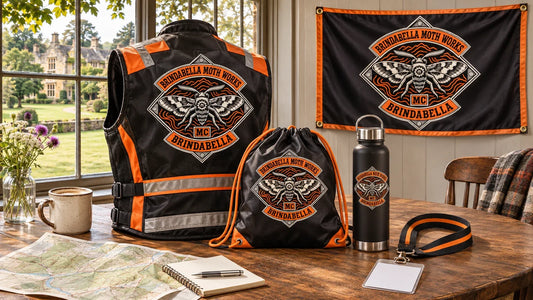
A club can use a private reference card to remember the start sequence or record provisional observations, but that card must never imply paddock access, media accreditation, marshal status or organiser authority. MotorClubShop's custom lanyard page discusses 10, 15, 20, 25 and 30 mm widths, printed polyester, dye-sublimated polyester, woven and nylon options. The correct combination depends on logo detail, repeat spacing, colour method, finished length, hardware and card-holder compatibility.
Build club-owned lanyards, not imitation passes
Send authorised artwork and confirm width, material, repeat spacing, hardware and the exact private card size in the proof. Keep event marks and access language off the design unless you have written permission.
Plan Custom Motorcycle Club Lanyards
The default 25-to-1 championship points scale
Unless otherwise stated, MNZ Rule 6.14a awards points from first to twentieth as follows:
25, 22, 20, 18, 16, 15, 14, 13, 12, 11, 10, 9, 8, 7, 6, 5, 4, 3, 2, 1.
The three-point gap from first to second and the two-point gaps through fifth make the top positions particularly influential. After fifth, most adjacent positions differ by one point. That arithmetic helps a spectator understand why a late pass matters, but it does not justify a self-published championship table. A classification can still be affected by eligibility, the completion threshold, penalties, protests and official corrections.
The 65% and chequered-flag condition
Rule 16.15 adds a condition that is easy to miss when someone copies only finishing positions: to gain championship points and/or prize money, a competitor must complete at least 65% of the distance covered by the winner and cross the finish line under the chequered flag. A rider appearing on a timing screen is therefore not automatically proven to have earned the points that a casual calculator assigns.
Do not estimate 65% from a photograph, a partial stream or the number of times you noticed a rider pass one viewing point. Use the official classification after timing and race control have applied the rule.
What the yellow, red, white and chequered signals mean
- Stationary yellow: go slow and ride cautiously; no jumping. It signals danger.
- Waved yellow: slow down immediately, proceed with extreme caution, do not overtake until past the danger, prepare to stop and do not jump.
- Red: all riders stop racing. Under Rule 6.13, a red flag is displayed when a race must be stopped because of an accident, climatic condition or another cause.
- White: the race leader has started the last lap.
- Black-and-white chequered: finish for all riders; it marks the end of the race subject to the complete-race rule.
Lights may supplement signals at approved flag points, but the current rules keep flags as the primary signalling method unless the track safety plan provides otherwise. A spectator should never move toward an incident, cross a barrier or imitate a signal. Follow venue staff and remain in the authorised public area.

What happens when a race is stopped
Rule 6.13 separates several situations. If a rerun takes place, only competitors who started the original race may take part; a rider who had retired or been excluded is ineligible for the rerun. If conditions deteriorate for a reason other than an accident, completing the planned distance is unsafe and a rerun is unlikely to be practical, the finish flag may be shown.
If the leader has completed more than 50% of the total laps or time when the race is stopped, the race is declared finished. The final result is taken from the last completed lap before the stoppage. “More than 50%” is not the same as “exactly half,” and a spectator cannot make the declaration. Race control determines the factual trigger and official classification.
How the tie-break works at the end of a series
MNZ Rule 6.7a first compares the number of best results: number of first places, then second places and so on. If the tie remains, it moves to the better placing in the last counting result, then the last-but-one, then the last-but-two and continues backward as required. If a dead heat still exists, the riders concerned divide applicable awards according to their placing.
This is why “same points” does not automatically mean a shared championship position, and why a calculator built before the final official classification can be wrong. The correct workflow is: record the provisional finish, wait for the published classification, apply any announced corrections, then consult the official series result.
Create a private clubhouse scoring wall
A wide custom event banner can identify a club's own viewing or review space, while removable tiles keep provisional notes visibly separate from official results. MotorClubShop's event-banner service starts from authorised club artwork and considers finished size, viewing distance, mounting method, edge finishing and eyelet placement. A club banner must not copy the championship, sponsor, organiser or venue identity.
Design a club-owned event banner
Provide your authorised logo, finished dimensions, mounting plan and viewing distance. Review the complete layout and construction proof before approving production.
Create a Custom Motorcycle Club Event Banner
A spectator's reliable finale-tracking workflow
- Confirm the class and session from official event output rather than guessing from motorcycle colour or sound.
- Observe the helmet-check and start boards, but do not predict the gate drop from your own stopwatch.
- Record only what you see, labelling every note provisional.
- If a red flag appears, stop calculating. Wait for an official rerun, finish or classification decision.
- Use the published result to check the 65% and chequered-flag boundary.
- Use the default points scale only if event output does not state an approved alternative.
- Resolve equal totals with the official tie-break sequence, then verify against the series classification.
MX Timing lists a live-timing route for the 2026/27 championship, but a live screen is an information tool, not permission to announce a final result ahead of the organiser. Refresh official channels after the meeting rather than preserving an early screenshot as the definitive table.
Practical custom tumblers for the club's own viewing setup
MotorClubShop's custom tumbler collection discusses powder-coated stainless styles and decoration approaches including laser engraving, screen printing, UV or digital printing and selected full-wrap methods, depending on the model and artwork. Confirm capacity, lid, finish, decoration area, colour proof and sample requirements. A logo tumbler is private club merchandise; it does not grant access or official status.
Coordinate custom club tumblers with authorised artwork
Choose the capacity and finish first, then approve how the logo wraps, prints or engraves on the selected surface. Keep names or roles off the design unless the club supplies and approves them.
Explore Custom Motorcycle Club Tumblers
Facts that remain unknown before Round 4
- the final accepted rider list, reserves and grid sizes;
- the final public running order and exact session start times;
- whether Rotorua will use boards or an approved electronic countdown;
- any race-specific restart, shortened-race, penalty or protest decision;
- official Round 4 classifications and final championship standings;
- the riders who will win races, awards or titles.
Those are post-publication facts, not gaps to fill with prediction. This guide will remain useful because it teaches readers how to interpret the official output once it exists.
Frequently asked questions
What is the start sequence for a New Zealand Championship motocross race?
The current rulebook specifies a helmet-strap check board, a 10-second board, a 5-second board, the 5-second board turning sideways and a gate drop within three seconds. An approved clock system may be used if explained at the riders' briefing.
How many points does a motocross race winner receive?
Unless otherwise stated, first receives 25 points, second 22 and third 20, descending to one point for twentieth.
Does every classified rider automatically score points?
No. For championship points or prize money, Rule 16.15 requires at least 65% of the winner's distance and crossing the finish under the chequered flag.
How is a championship points tie decided?
Best results are counted first—wins, then second places and so on. If still tied, the better last counting result is compared, then earlier counting results working backward.
What happens if a race is red-flagged after more than 50%?
If the leader has completed more than 50% of the scheduled laps or time, the rule says the race is declared finished and classified at the last completed lap before the stoppage. Officials make that determination.
Official sources
- MNZ Round 4 event page — date, venue, address, host and approved permit.
- MNZ motocross discipline page — four-round 2027 championship calendar and Rotorua finale position.
- MNZ Off Road Chapter 16, Version 2.0 — start procedure, 65% points condition and motocross track/start-area rules.
- MNZ Off Road Chapter 6, Version 2.0 — points, tie-breaks, flags and stopped-race classification.
- MX Timing live-timing directory — official championship timing route; final classifications remain subject to official publication.
Last fact-check: 17 November 2026. All product visuals are original private-club concepts using authorised Brisbane Range Union artwork. They do not depict the Rotorua event, its riders, officials, credentials or official merchandise.
Etiquetas:
Anterior
2027 Rotorua NZ Motocross Classes: MX1, MX2, MX125, WMX & MX3
Siguiente
VCC National Motorcycle Rally 2027 Late Entry Guide: Deadline, Fees & Routes
Artículos relacionados

ABR Festival 2027 Test Rides & Trail Pass Guide
Nov 17 2026