
Full-Grain vs Top-Grain Leather Crossbody Bags
Full-grain leather retains the hide's complete natural grain surface, while top-grain leather has had the outer surface corrected or refined to create a more uniform finish. Neither label alone determines whether a crossbody bag is right for you: compare the exact animal hide, tanning process, thickness, construction, finish, capacity and care requirements stated for the individual bag.
Full-grain and top-grain are not tanning methods
“Full-grain” and “top-grain” describe how the hide surface is retained or processed. “Vegetable-tanned” describes a tanning method. A bag can therefore be both vegetable-tanned and full-grain, or vegetable-tanned and top-grain. Terms can be used inconsistently across the market, so rely on the exact product specification instead of guessing from color, price or photography.
Top-grain leather in a soft bag
Top-grain leather can be supple and light when the hide and construction are selected for drape. The grain classification does not tell you the bag's stiffness or weight by itself.

The listing specifies supple top-grain lambskin, a naturally creased finish and a broad soft croissant shape.
Top-grain leather in mixed construction
A grain label may apply only to leather components in a mixed-material bag. Check which panels are leather, how load points are reinforced and how the other material should be cared for.

This chest bag combines Italian vegetable-tanned top-grain cowhide with waxed canvas and solid-brass hardware.
Full-grain leather in a structured bag
Full-grain leather preserves the natural grain surface, so markings, variation and developing patina are expected. Structure still depends on thickness, lining, panel design and reinforcement.

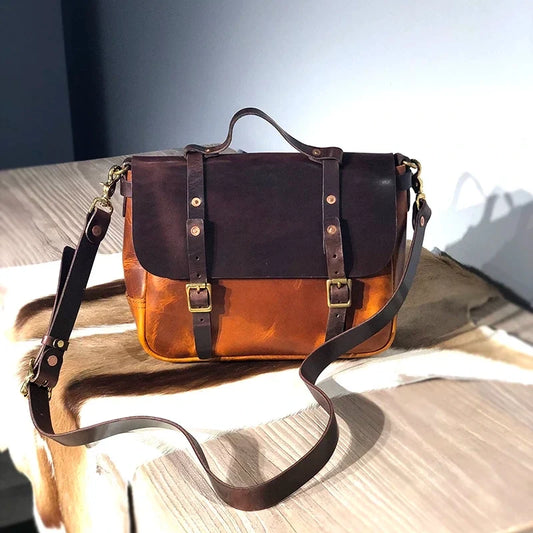
This messenger bag is specified as thick vegetable-tanned full-grain cowhide with a hand-dyed, softly burnished finish.
Top-grain trim in a textile-led bag
When leather is used as trim, judge the entire build. Seams, zipper attachment and strap anchors matter at least as much as the leather grade.

This bag pairs selvedge denim with 2–3 mm top-grain vegetable-tanned cowhide trim and an adjustable leather strap.
How finishing changes top-grain leather
Washing, distressing, pigmentation and protective finishes can change hand feel and appearance. A deliberately distressed surface is not automatically damage, but it needs care suited to that finish.

The product specification identifies heavily washed top-grain cowhide with natural grain, creasing and tonal variation.
When a listing names the hide but not the grain grade
Do not infer full-grain or top-grain from a photo. If a listing states only the animal hide, treat that as the confirmed fact and assess construction, finish and care separately.

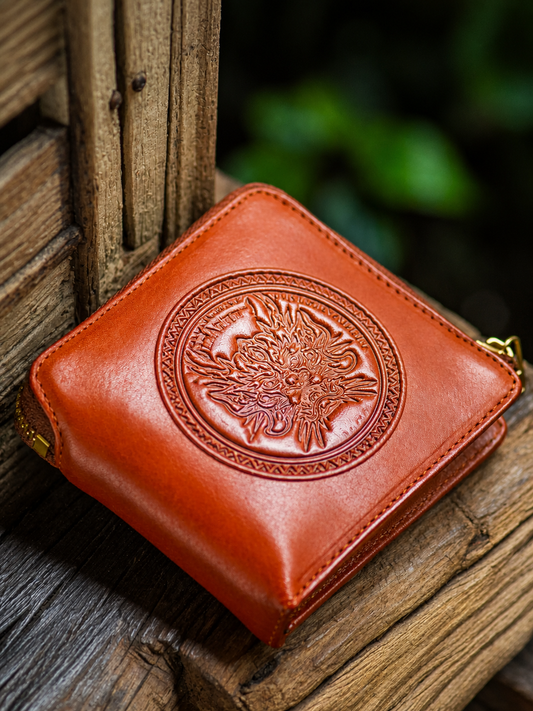
This asymmetric bag is specified as pure horsehide; the listing does not assign a full-grain or top-grain grade.
Full-grain vs top-grain comparison
| Factor | Full-grain | Top-grain |
|---|---|---|
| Surface | Natural grain surface retained | Surface may be corrected or refined |
| Appearance | Natural variation is common | Often more uniform, depending on finish |
| Best buying check | Thickness, finish, construction and care | Hide type, correction, finish and care |
How to choose
- Confirm whether the listing explicitly says full-grain, top-grain or only names the hide.
- Separate grain grade from tanning method.
- Check thickness, structure, lining, seams and strap anchors.
- Compare dimensions and opening shape with a real carry list.
- Choose the finish and expected patina you will maintain.
- Follow product-specific care instructions.
Frequently asked questions
Is full-grain always better than top-grain?
No. Full-grain preserves the natural surface, but suitability depends on design, finish, construction, intended use and care.
Is top-grain genuine leather?
Yes. Top-grain is leather from the upper portion of the hide whose surface may be refined for a more consistent finish.
Is vegetable-tanned leather always full-grain?
No. Vegetable tanning and grain grade describe different attributes.
Can photos prove a grain grade?
No. Use the written product specification; appearance alone is not reliable evidence.
Which develops the best patina?
Patina depends on hide, tanning, finish, use and care—not one label alone.
Materials and availability verified against active Motor Club Shop listings on September 13, 2026. Current product and variant details take priority.
Etiquetas:
Anterior
How to Choose Skull Rings as a Gift
Siguiente
Stock vs Aftermarket Motorcycle Lighting: Key Differences
Artículos relacionados
How to Inspect and Maintain Motorcycle Lighting
Sep 13 2026
How to Choose Skull Rings as a Gift
Sep 13 2026
Leather Backpack Size, Capacity and Fit Guide
Sep 13 2026