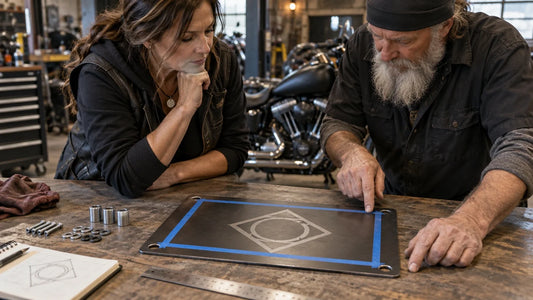

How to Choose Plaque Materials and Finishes for the Display Location
Quick answer: Choose a plaque material and finish only from the supplier’s documented options for the real display location. Confirm the actual substrate, surface process, coating, lettering treatment, mounting method, and care guidance. Compare applicable physical samples under similar lighting and do not treat a color name or “outdoor look” as evidence of suitability.
A controlled commemorative plaque material finish display decision starts with specifications, not assumptions. See the Custom Club Commemorative Plaques buying guide for the full ordering workflow; use this guide to document how the offered construction relates to the display environment.
Describe the actual display environment
State whether the location is indoors, in a conditioned or unconditioned room, under a covered exterior area, or fully exposed. Note direct sun, routine moisture, cleaning practices, airborne dust, temperature changes, and contact risk only as observed conditions. Ask the merchant which current construction is offered for that description and what limitations apply.
Do not translate “metallic,” “antique,” “brushed,” or “bronze-tone” into a substrate. Those words can describe appearance. Request the base material, any face layer, coating or seal, edge treatment, backing, and mounting components in writing.

Compare lettering treatments on applicable samples
| Treatment | What to inspect | What to document |
|---|---|---|
| Engraved | Cut depth appearance, fill if offered, edge clarity, contrast | Actual substrate, process, finish, and approved sample |
| Printed | Color relationship, small detail, surface sheen, edge handling | Print and coating description plus care guidance |
| Dimensional | Layer depth, shadows, projections, seams, backing | Materials by layer, finished depth, weight, and mount |
These are inspection categories, not performance promises. Evaluate the same authorized emblem and comparable inscription detail where possible. A different design on each sample makes it difficult to separate construction differences from artwork differences.

Review samples in representative light
Move applicable samples into lighting similar to the intended display. View them from normal distance and angle, then inspect edges and small inscription detail close up. Look for usable contrast and whether surface reflections hide essential information. For a display behind glass or inside a case, evaluate that additional reflection and depth constraint.
Ask how the offered finish should be cleaned and which products or methods should be avoided. Care instructions should apply to the quoted plaque construction; generic metal-care advice may not suit a coating, printed layer, fill, adhesive, or mixed-material assembly.

Do not approve an unspecified finish
Reject a proof or quote that shows a convincing bronze, black, silver, or weathered appearance but leaves the material and finish unnamed. The corrected approval record identifies actual substrate, lettering process, face and edge finish, coating if any, finished dimensions and depth, display environment, mounting method, sample reference, care guidance, and merchant-stated limits.
If the display changes, return to the supplier. A configuration reviewed for an indoor wall should not be presumed appropriate for a damp, sunlit, coastal, or fully exposed location. Likewise, a finish name from a previous order does not guarantee the same current material or process.
Keep open questions visible through quoting
Use a three-state specification sheet: confirmed by the merchant, selected by the club, or still open. Substrate and coating belong in the first category; preferred appearance and display priority may belong in the second; unquoted tolerances, schedules, and exposure limits remain open. Never turn an unanswered field into a claim while rewriting the brief.
When the merchant provides a sample, give it an identifier and state exactly what it represents. A finish chip may approve color and sheen but not engraved detail, edge treatment, final depth, or mounting. A completed sample can answer more questions, but only for the materials and process it actually uses. Save the inspection date and reviewer with that record.
Frequently asked questions
Is a bronze-colored plaque necessarily bronze?
No. Color and finish names do not identify the substrate. Request the actual material and surface specification.
Which treatment lasts longest?
There is no responsible universal answer without the exact materials, coating, display conditions, care, and supplier evidence.
Can an indoor sample approve an outdoor order?
Only if the supplier documents that the exact offered construction suits the specified exposure; appearance alone is not evidence.
Why compare samples under display lighting?
Light and viewing angle change perceived contrast, reflections, shadows, and the visibility of small inscription detail.
What finish information belongs in the approval?
Record actual substrate, process, color or surface treatment, coating, edge treatment, depth, mount, environment, sample, care, and stated limitations.
Request a plaque material and finish review
Send your authorized artwork, quantities and completed measurement or sample checklist to request a design and quote review for commemorative plaques.
Explore Custom Commemorative Plaques
Verify the exact current construction and its documented display limitations before approval.
Etiquetas:
Anterior
Custom Club Commemorative Plaques: Buying Guide for Club Organizers
Siguiente
Custom Club Commemorative Plaques: Buying Guide for Club Organizers
Artículos relacionados
How to Prepare a Club Decal for a Curved Surface
Sep 17 2026