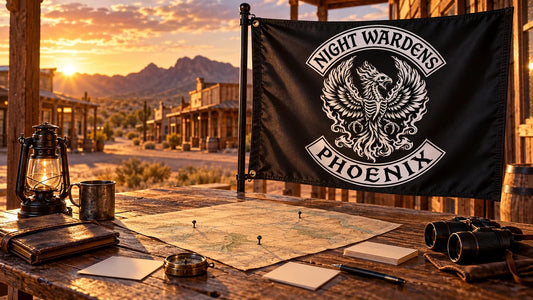
Iron RYDR Challenge 2026: Individual Verification and a Club-Flag Plan
Direct answer: a motorcycle club preparing for the Iron RYDR Challenge 2026 should treat entry as an individual-rider process, not a single club registration. Give every rider one private verification file, keep the club roster limited to status rather than personal documents, and run the club-flag project as a separate artwork and display plan. Our practical framework is ONE RIDER / ONE FILE / ONE FLAG.
This article is an independent editorial planning guide for club officers and participating riders. It is not an official instruction, entry confirmation, endurance-training plan or medical advice. MotorClubShop is not affiliated with RYDR, Moto Heads or the event organizer. The club marks in our original illustrations come from authorized customer artwork and are shown only on custom club flags—not as event credentials or organizer merchandise.
What the organizer has published
| Published item | Organizer information | Club planning response |
|---|---|---|
| Date and start | December 12, 2026; Hoskote, Bengaluru | Confirm each rider against the latest official notice |
| Challenge | 1,100 km within 24 hours | Do not turn club participation into pressure to continue |
| Entry model | Individual registration and verification | One private file and one status owner per rider |
| Club identity | Club name and club flag may be represented, including a single rider | Use only authorized artwork and a static display plan |
| Deadlines | Early bird through November 16; close November 30 | Set an earlier internal review date |
The official page also describes document verification, rest expectations and safety conditions. Those are organizer requirements, not optional club preferences. A club coordinator can help members see what is outstanding, but should not approve documents on the organizer's behalf or promise that anyone will be accepted.
The ONE RIDER / ONE FILE / ONE FLAG system
One rider means every participant owns the decision to register and the responsibility to follow current organizer rules. One file means required records are kept in a restricted location rather than copied into a group chat. One flag means the club prepares a single approved identity brief with a named custodian, dimensions and a safe static-display plan.

One rider: preserve individual responsibility
A large club spreadsheet can create a false sense that the secretary has “registered everyone.” The official page says verification is individual, so the club's shared view should show only operational states such as not started, submitted, organizer response received and rider reconfirmed. It should not contain licence numbers, insurance files, medical information or emergency-contact details.
Nominate one coordinator for questions and one backup, but keep the boundary clear: they can point riders to the official page and record a status supplied by the rider. They cannot interpret acceptance, waive a condition or make a go/no-go decision for someone else.
One file: build a private verification packet
Each rider's file should have a simple index: registration receipt or reference, organizer correspondence, document-review status, and the date the rider last checked the event page. Store it in a restricted folder controlled by that rider or an expressly authorized officer. A club-wide roster needs only initials or an internal member code plus a status and review date.
Never photograph actual documents for a promotional post. Never place a readable licence, address, phone number, payment reference or emergency contact in an image-generation prompt. The visual below deliberately uses a sealed abstract folder to show the process without exposing real records.

One flag: approve the artwork before production
A club flag is an identity item, not proof of event registration. Start with a written authorization from the club officer or artwork owner. Confirm the exact logo file, colors, orientation, finished dimensions, edge treatment and where the flag will be displayed. Do not add the Iron RYDR, RYDR or Moto Heads name, badge or event artwork unless the rights holder has expressly authorized it.
Request a visual proof that shows the club mark on the actual rectangular flag area. Check spelling and small details at full size, then record the approving person's name and date. The same logo should remain visible on every product image used in the article; generic blank products or unrelated retail-product imagery do not meet that standard.

A safe static-display plan
The most useful flag plan answers five questions: who carries it, who sets it up, where it stands, when it comes down and where it is stored. Use a weighted freestanding base in a designated stationary area only after permission from the site operator. Keep clear of traffic lanes, check-in queues, emergency access, fuel areas and moving motorcycles.
Do not attach a large flag to a motorcycle for public-road riding based on this article. Wind load, mounting hardware, local law and organizer rules create risks that require competent, situation-specific assessment. The editorial recommendation here is deliberately narrower: display the club flag while people and motorcycles are stationary, then remove it before departure.

A deadline sequence clubs can audit
- Now: each rider reads the official page and decides independently whether to proceed.
- Before November 16: anyone considering the published early-bird window checks current terms directly with the organizer.
- By November 20: the club conducts an internal status review without collecting unnecessary personal data.
- Before November 30: every rider verifies that their own process is complete; the coordinator does not infer acceptance from payment alone.
- One week before the event: recheck organizer messages, flag-display permission, weather and current travel conditions.
November 20 is our editorial buffer, not an organizer deadline. It creates room to resolve questions before the published November 30 close. If the official page changes, the organizer's current information takes precedence.
Club coordinator's final checklist
- Every participant understands that registration and verification are individual.
- The shared roster contains statuses, not copies of identity or vehicle documents.
- No officer has promised acceptance or interpreted organizer approval.
- The flag uses one exact, authorized motorcycle-club logo and no copied event branding.
- The artwork proof, dimensions, custodian and static location are approved.
- The group has a plan to remove the flag before motorcycles move.
- Everyone will recheck the official event source before payment, travel and attendance.
Frequently asked questions
When and where is the Iron RYDR Challenge 2026?
The official page lists December 12, 2026, with the start from Hoskote, Bengaluru. Check the organizer source again before travel.
Can a motorcycle club register as one group?
The organizer says registration and verification are individual. Riders may still list their club and represent it with a club flag.
Can one rider represent a motorcycle club?
The official page indicates that a club name and flag can be represented even by a single rider, subject to the organizer's current rules.
What should a club keep in its shared roster?
Keep only an internal identifier, operational status, last-check date and coordinator note. Personal documents should remain in a restricted rider file.
May the flag use the event logo?
Not without express authorization from the rights holder. The safest brief uses only the club's authorized artwork and does not imply event endorsement.
Source and image note: event facts were checked on October 28, 2026 against the official Iron RYDR page. All five original visualizations in this article place an exact authorized motorcycle-club logo directly on a custom flag product: Kinship Road Bandar Seri Begawan, Iron Helmets Bandung, Oni Rebels Kyoto, Dark Mile Chiang Mai and Fortune Aces Manila. They do not depict official Iron RYDR merchandise or affiliation.
Etiquetas:
Anterior
Fall Spyder, Bike & Trike Fest 2026: A PACKET Check-In & Lineup Plan
Siguiente
GO AZ Vintage Motorcycle Show 2026: Class, Registration and Club Plan