

Hardware, Stitching and Closures Used in Leather Crossbody Bags
Leather crossbody-bag durability depends on more than the hide. Inspect strap anchors, stitching consistency, seam placement, zipper attachment, buckles, snaps, rivets, lining and reinforcement at load points. A closure should suit how you use the bag, while hardware should move smoothly and remain securely attached without sharp edges or visible stress.
Soft leather needs supported attachment points
On a supple bag, inspect where the wide strap joins the body and where the zipper is sewn into the curved opening. Soft drape should not hide pulled stitches or distorted anchor points.

This top-grain lambskin bag uses a broad adjustable strap, zip opening and softly structured curved body.
Hardware in mixed-material construction
Where leather meets canvas, look for clean transitions and reinforcement at zipper ends, snap pockets and strap attachments. Different materials place different stress on the same seam.

This chest bag combines top-grain cowhide, waxed canvas, a front snap pocket, zipper and solid-brass hardware.
Buckles, rivets and flap closures
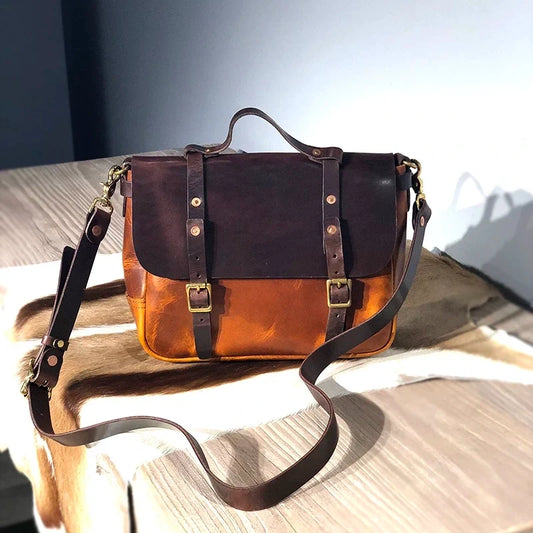
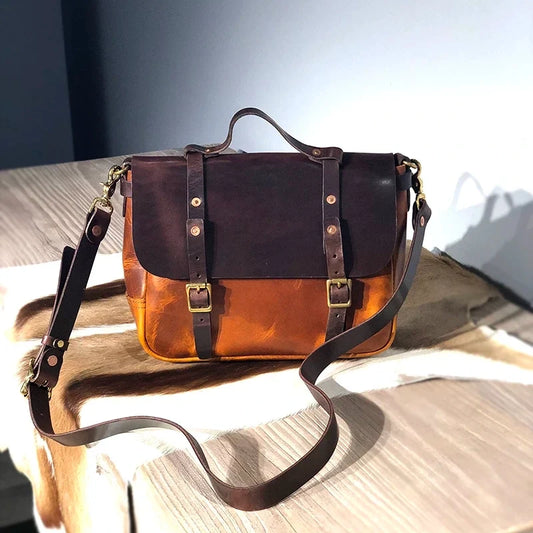
Buckle-led messenger bags spread closure forces across straps and hardware. Check buckle tongues, holes, rivets and the stitching that secures each strap; decorative buckles may conceal quick-release hardware on some designs, so verify the exact listing.

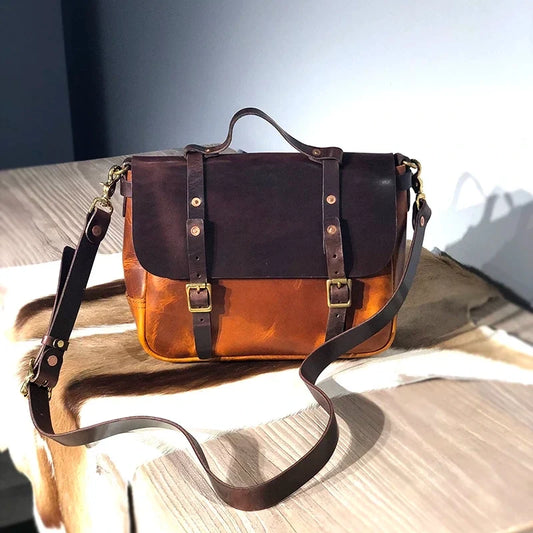
This structured messenger uses twin buckle straps, solid-brass hardware, a top handle and an adjustable shoulder strap.
Zippers and pockets in textile-led bags
Inspect the zipper tape, end stops and seam allowance where a zipper crosses from denim to leather trim. Multiple compartments improve organization but add closures and seam junctions to check.

This denim-and-leather bag has a main zip compartment, front and rear pockets, and top-grain cowhide reinforcement.
Removable straps, rings and clasps
Removable straps increase carrying options but also add clasps and rings that bear load. Check that gates close fully, rings are not distorted and attachment tabs show no tearing.

This saddle bag uses solid-brass hardware, a thick cotton lining and two removable straps.
Curved zipper paths and asymmetric openings
An angled zipper should run without binding through the full path. Check whether the opening shape strains the corners when the bag is packed and whether the strap hardware stays flat against the body.

This asymmetric horsehide bag uses a curved silhouette, brass-tone YKK zipper hardware and an adjustable strap.
Construction comparison
| Component | What to inspect | Warning signs |
|---|---|---|
| Stitching | Even tension and reinforced load points | Skipped, loose or pulled stitches |
| Zippers | Smooth travel, secure tape and end stops | Binding, separation or fraying |
| Buckles and snaps | Positive engagement and secure mounting | Loose posts, sharp edges or distortion |
| Strap anchors | Layered reinforcement and flat hardware | Tearing, stretching or pulled seams |
Pre-purchase inspection checklist
- Identify every closure and how it opens with one hand.
- Inspect stitching at strap anchors, handles and zipper ends.
- Check whether rivets and rings sit flat without sharp edges.
- Confirm lining and pocket seams are finished.
- Review removable clasps and adjustment hardware.
- Compare construction with the expected load rather than size alone.
Frequently asked questions
Are metal zippers always better?
No. Suitability depends on zipper quality, size, attachment and intended use.
Do more rivets mean a stronger bag?
No. Rivet placement, material and surrounding reinforcement matter more than count.
Are buckles safer than zippers?
Neither is universally better; choose by access needs, load and construction.
Where does stitching usually face the most stress?
Strap anchors, handles, zipper ends, pocket corners and closure tabs commonly carry concentrated loads.
Construction details and availability verified against active Motor Club Shop listings on September 13, 2026. Current product details take priority.
Etiquetas:
Anterior
How Leather Crossbody Bags Handle Rain, Heat and Daily Riding
Siguiente
What Fits in Leather Crossbody Bags? Practical Packing Guide
Artículos relacionados
How to Inspect and Maintain Motorcycle Lighting
Sep 13 2026
Full-Grain vs Top-Grain Leather Crossbody Bags
Sep 13 2026