
Embroidered, Leather or Metal Club Keychains? How to Compare
Quick answer: Compare embroidered leather metal club keychains with the same authorized emblem, finished tag dimensions and attachment position. Embroidery can suit a flexible textile expression, leather can suit a quieter cut or decorated tag, and metal can suit crisp solid geometry—but those are starting points, not guarantees. Use only options the merchant confirms, examine front, reverse and edge construction, and approve a representative physical sample before choosing.
This article owns the material-and-process comparison. Attachment selection, group quantities and the full procurement workflow belong in the Custom Biker Keychains buying guide.
Embroidered, leather or metal club keychains: how to compare
| Candidate | Evidence to inspect | Questions to leave with the supplier |
|---|---|---|
| Embroidered | Threaded face, edge finish, reverse, flexibility and clarity of the simplified emblem | Offered base, decoration method, colors, minimum detail, dimensions, care and tolerance |
| Leather | Surface, cut edge, reverse, connection point and whether decoration is recessed, printed or otherwise applied | Actual offered material, finish, decoration route, thickness, color variation, care and tolerance |
| Metal | Relief or printed/filled detail, edge, reverse, finish and attachment connection | Base metal, plating or finish, color route, dimensions, thickness, care and tolerance |
Do not describe leather type, metal composition, thread specification, weather resistance or service life unless the current merchant evidence confirms it for the quoted sample. The visual category is not a specification.
Confirm finished tag dimensions, artwork detail and front/back construction
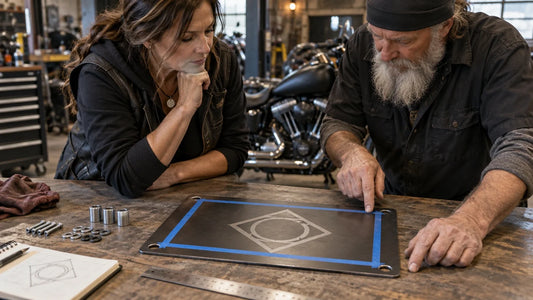
Create a product-specific sheet with three columns: confirmed, requested and open. Put the finished tag width and height with units in the correct column. Do the same for thickness, usable artwork area, connection point, attachment, edge treatment and reverse. This prevents a desired dimension from being mistaken for an offered dimension.
For artwork detail, identify the smallest essential letter, line, gap and enclosed space in the authorized design. Ask the supplier how it proposes to adapt those elements for each offered process. For front/back construction, specify whether the reverse is decorated, plain, stitched, backed, stamped or otherwise finished only after the merchant confirms the actual route.

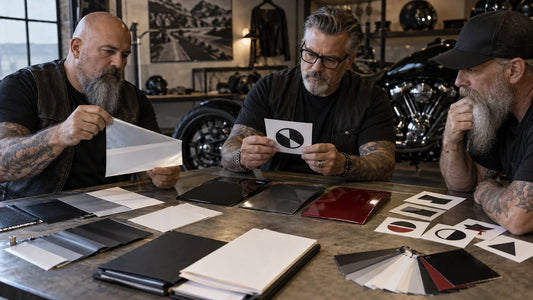
Compare the offered options with the same original club artwork
Simplify one authorized emblem enough that it can be tested fairly across the offered routes. Keep its outer dimensions, orientation and connection clearance constant. Ask the supplier to mark intentional adaptations—such as opening a narrow gap or reducing a fine interior detail—rather than silently producing three different interpretations.
Then compare one variable at a time:
- Material/process: review applicable merchant samples at the intended scale.
- Color or finish: compare the actual offered swatch, thread, surface or finish evidence under neutral light; a screen rendering is not a physical match.
- Single- or double-sided treatment: inspect the reverse and state its job. Do not assume a two-face option is offered for every material.
- Attachment: keep hardware constant during material comparison, or document the hardware change as a second variable.

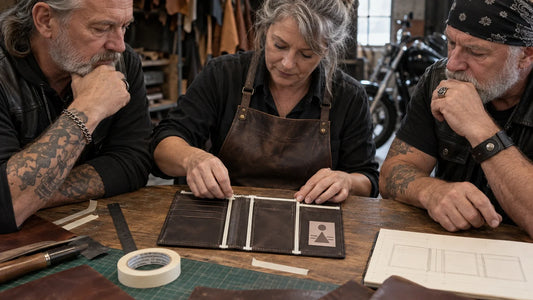
Use the same emblem on three actual-size proofs
- Print each front and reverse at the intended finished size.
- Place applicable physical samples beside the proofs.
- Check primary identity, smallest essential detail, edge clearance and hardware clearance.
- Flex only samples intended to flex; do not turn casual handling into a durability test.
- Record substrate, decoration route, attachment and reverse construction as separate choices.
One common rejection case is an attractive front proof with no defined reverse. The fix is not “finish the back nicely.” Ask the supplier to show the offered reverse construction, connection point and orientation, then add that view to the controlled proof. Acceptance means every face and edge being ordered is represented and tied to the same sample.
Approve the specification and sample as one record
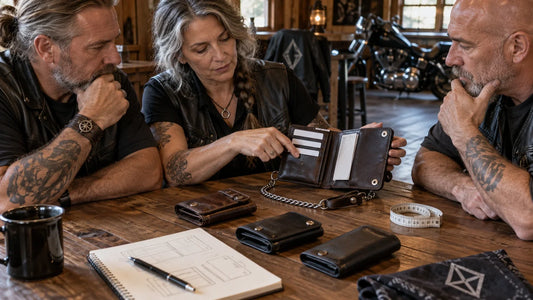
Check the final sample against finished tag dimensions, authorized artwork revision and front/back construction. Record the chosen substrate description exactly as the supplier provides it, the decoration method, finish or color reference, attachment, sample ID, proof version, named approver and date. Mark deviations explicitly. If a sample is representative rather than identical to the order, record what it does and does not verify.

Frequently asked questions
Which club keychain material holds the most detail?
That cannot be answered responsibly by material name alone. Finished size, artwork, specific decoration process and supplier limits matter. Compare the same artwork on applicable samples and ask for product-specific confirmation.
Can the club compare colors from a screen proof?
A screen proof can show placement and approximate relationships, but physical thread, leather surface, ink, fill or metal finish should be checked with current supplier evidence where color matters.
Is a double-sided keychain available in every material?
Do not assume so. Ask what front and reverse treatments are currently offered for the exact material, size, attachment and quantity.
What causes a material proof to be rejected?
Reject it when dimensions, artwork adaptation, attachment, reverse construction or sample identity are missing or when requested values are presented as confirmed without supplier evidence.
Request a material and quote review
Send your authorized artwork, quantities and completed measurement or sample checklist to request a design and quote review for custom biker keychains.
Explore Custom Biker Keychains Read the buying guide
Confirm current material, process, sample and quote details before production.
タグ:
以前の
Custom Club Hoodies: Buying Guide for Club Organizers
次へ
Custom Club Hoodies: Buying Guide for Club Organizers
関連記事
How to Prepare a Club Decal for a Curved Surface
Sep 17 2026