

Leather Crossbody Bags: Size, Capacity and Fit Guide
Choose a leather crossbody bag by measuring the largest item you carry, comparing all three bag dimensions, checking the pocket layout and confirming that the adjustable strap fits your intended shoulder or crossbody position. Treat product capacity lists as examples, not guarantees: cases, bottles, documents and layered contents change usable space and loaded weight.
Build a real carry list first
Place your phone with its case, wallet, keys, glasses, bottle, umbrella, documents and other daily items on a table. Measure the largest rigid item and note which objects must stay separated. Add space for easy removal and closure travel.
Do not assume that a bag holding an A4 document will also hold every laptop, or that a phone-compatible bag fits every device and case.

This approximately 42 × 23.5 cm lambskin bag lists an A4 document among example contents and uses an approximately 104 cm long, 5 cm wide strap.
Compare length, height and depth
Length and height show whether the largest item can enter the bag; depth determines how layered objects build outward. Exterior dimensions include leather, seams and structure, so usable space is smaller.
A curved or tapered body may have less rectangular capacity than its maximum dimensions suggest. Compare the compartment shape as well as the published numbers.

At approximately 27 × 17 × 9 cm, this compact chest bag is sized for a phone, wallet, small bottle and keys; its strap adjusts up to about 100 cm.
Match documents and tablets by exact size
“Tablet capacity” is incomplete without a device size, case and compartment opening. Measure the cased device in three dimensions. Check that it can pass the zipper or flap and sit without stressing corners.
Documents also need clearance to stay flat. Avoid forcing paper against a curved top or overfilling the compartment around a device.

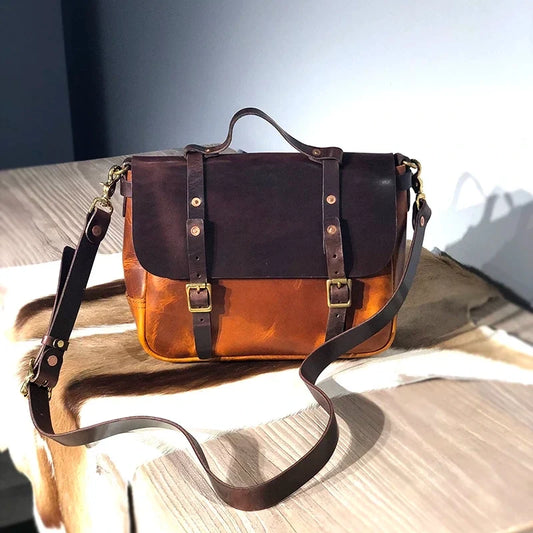
This structured 32 × 23 × 10 cm messenger bag lists A4 documents and an iPad or 10-inch tablet, with an empty weight of approximately 830 g.
Use pockets to control usable capacity
Pockets improve organization but their seams and contents consume internal space. Assign thin items to slip pockets, valuables to secured pockets and frequently used items to accessible sections.
Keep keys and other hard objects away from screens. Confirm whether exterior pockets close securely enough for their intended contents.

This 28 × 20 × 12 cm denim-and-leather bag combines a main zip compartment, two interior slip pockets, front and rear pockets, and a 100–125 cm strap.
Check strap range and carry position
Measure from the intended attachment point across the body to the opposite hip while wearing typical clothing. Compare that path with the published strap range. Bag shape, attachment height and torso size affect where the bag sits.
A short strap may suit shoulder carry but not the desired crossbody drop. A narrow strap can feel different under a loaded bag than a wider one, so consider bag weight and expected contents together.

This 26 × 15 × 7.5 cm saddle bag includes a 60 cm short strap and a 114–128 cm long strap for different carry positions.
Plan for loaded weight
Add the empty bag weight to every item in the packing list. Water, tablets and metal accessories increase the total quickly. The bag should sit close without pulling the shoulder, swinging excessively or restricting movement.
When riding, use only a carry method intended for the product and confirm the bag cannot interfere with controls, steering, visibility or protective gear.

This approximately 310 g mini horsehide bag measures about 30 × 17 × 9 cm and provides a seven-hole strap range of approximately 77–110 cm.
Size and fit checklist
| Check | What to compare |
|---|---|
| Largest item | Cased dimensions versus opening and compartment |
| Bag body | Length × height × depth and curved/tapered areas |
| Organization | Main compartment, slip, zip and exterior pockets |
| Strap | Minimum/maximum length, width and attachment height |
| Weight | Empty bag plus complete daily load |
| Movement | Walking, sitting and intended riding position |
Five-minute fit test
- Measure the largest rigid item with its normal case.
- Compare all three dimensions and the bag opening.
- Assign items to actual compartments.
- Measure your preferred strap path over typical clothing.
- Add empty bag weight to the planned contents.
- Check closure clearance and easy access.
- Test a similarly sized load while sitting and moving.
Frequently asked questions
Are exterior dimensions the same as usable capacity?
No. Seams, lining, structure, pockets and curved areas reduce usable space.
How do I know whether a tablet fits?
Measure the cased device and compare it with the usable compartment and opening.
What strap length do I need?
Measure your intended crossbody path over normal clothing and compare it with the bag’s adjustment range.
Should I choose the largest bag?
Not automatically. Choose enough space for the real carry list without unnecessary bulk or loaded weight.
Can I wear any crossbody bag while riding?
No. Confirm the intended carry method and ensure the bag cannot interfere with controls, movement, visibility or protective gear.
Dimensions, strap ranges, pocket layouts, weights and current availability verified against active Motor Club Shop listings on September 12, 2026. Measurements are approximate; current product-page specifications take priority.
タグ:
関連記事
How to Inspect and Maintain Motorcycle Lighting
Sep 13 2026
Full-Grain vs Top-Grain Leather Crossbody Bags
Sep 13 2026
How to Choose Skull Rings as a Gift
Sep 13 2026
Leather Backpack Size, Capacity and Fit Guide
Sep 13 2026