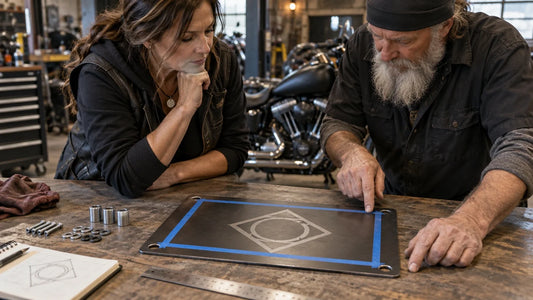

Flat Tin-Style Wall Art or Dimensional Metal Club Signs?
Quick answer: Choose flat tin-style wall art when a low-profile graphic panel matches the display; choose a dimensional metal sign when visible depth, layered construction, and shadow are intentional. In either case, confirm the actual substrate, edge, finish, total depth, weight, mounting back, display limits, and care instructions. The category name alone does not establish material or outdoor suitability.
The tin wall art dimensional metal club signs decision is best made with front, edge, and back evidence. See the Custom Clubhouse Metal and Tin Signs buying guide for the complete ordering workflow; this comparison isolates construction and display tradeoffs.
Define flat and dimensional without assuming material
A flat tin-style sign is generally a comparatively thin wall-art panel whose visual message comes primarily from its face. A dimensional metal sign uses raised layers, spacers, formed sections, relief, or other depth-producing construction. Those descriptions do not state the actual metal, gauge, face layer, coating, attachment method, or exposure rating.
Ask the merchant to identify every material in the quoted assembly and to provide finished dimensions, total projection, edge treatment, back view, approximate weight if available, and mounting method. If a listing or proof says only “tin,” “steel look,” “vintage metal,” or “outdoor style,” request a complete product-specific specification.

Compare the same emblem across treatments
| Option | Inspect | Confirm |
|---|---|---|
| Flat printed | Color, small detail, sheen, edge folds or cuts | Substrate, print system, coating, mount, care |
| Flat engraved | Mark depth appearance, fill if offered, contrast | Substrate, process, finish, edge, mount |
| Dimensional | Layer depth, shadows, seams, projections, back | Materials by layer, total depth, weight, hardware |
Compare one authorized artwork revision on applicable samples. If each construction uses a different design, differences in detail and visual impact may come from the artwork rather than the sign. View samples at the intended distance, from oblique angles, and under representative light.

Match construction to the wall
Record available width, height, projection, viewing distance, and nearby doors or traffic. A dimensional sign needs enough wall clearance and may cast useful or distracting shadows depending on the lighting. A flat panel may have lower projection but still requires planned holes, edges, standoffs, or another mounting back.
Have a qualified installer review the actual wall, product weight, mount, and included hardware. Do not treat generic fasteners as suitable for every substrate. Keep mounting holes and construction features outside the protected logo safe area according to supplier drawings.
Document finish, exposure, and care
Tell the merchant whether the location is indoors, covered, or exposed and describe observed sun, moisture, dust, cleaning, and contact conditions. Ask whether the exact quoted substrate, finish, assembly, and mounting system are offered for that setting. An indoor sample should not be used as proof of outdoor suitability without current documentation.

Save applicable cleaning and care instructions with the approval. Coatings, printed layers, fills, adhesives, spacers, and mixed-metal assemblies may require different treatment. Avoid promising corrosion resistance, color life, or weather performance without evidence for the exact offered configuration.
Reject the unspecified proof
A front mockup can approve artwork placement but cannot approve construction when the substrate and finish are blank. The corrected record names the format, actual materials, face process, edge treatment, finished depth, weight if supplied, mounting back, holes or fixtures, coating, display environment, care, sample reference, and current merchant limitations.
Make the selection traceable
Label every reviewed sample and photograph its front, edge, and back beside a neutral size reference. Record which attributes it approves and which remain open. If the final quote substitutes a substrate, finish, backing, or mounting method, treat that as a new decision rather than assuming the visual mockup still governs. This discipline is especially important when flat and dimensional variants share nearly identical front artwork.
Frequently asked questions
Is tin-style wall art necessarily tin?
No. It is a format description. Confirm the actual substrate and construction for the quoted product.
Is a dimensional sign always better?
No. It is appropriate when depth suits the artwork, wall, sightline, mounting, budget, and maintenance plan.
Can a front mockup show total depth?
No. Request edge and back views plus a written dimension or physical sample.
Are metal signs automatically suitable outdoors?
No. Suitability depends on the exact material, coating, assembly, mounting, exposure, and supplier documentation.
What should remain the same in a sample comparison?
Use the same authorized emblem, comparable finished size, representative lighting, and defined viewing position whenever possible.
Request a flat or dimensional sign review
Send your authorized artwork, quantities and completed measurement or sample checklist to request a design and quote review for metal signs / tin signs & wall art.
Explore Custom Metal Signs Review Tin Signs & Wall Art
Verify the exact substrate, finish, display limitations, and mounting construction before approval.
タグ:
以前の
Custom Clubhouse Metal and Tin Signs: Buying Guide for Club Organizers
次へ
Custom Clubhouse Metal and Tin Signs: Buying Guide for Club Organizers
関連記事





How to Prepare a Club Decal for a Curved Surface
Sep 17 2026