
How to Choose a Biker Wallet Layout for the Intended Carry
Quick answer: Choose a biker wallet layout by listing the actual card and cash formats, loading those representative contents into the offered sample, testing the access order, and recording its open and folded dimensions. Accurate custom biker wallet layout dimensions distinguish outside size from usable pocket capacity and show whether the loaded wallet closes without forcing the fold.
This article addresses internal layout and carry. Use the Custom Biker Wallets buying guide for the broader construction, artwork, sample and quote workflow. Confirm the current offer through the Wallets collection.
List the actual carry contents
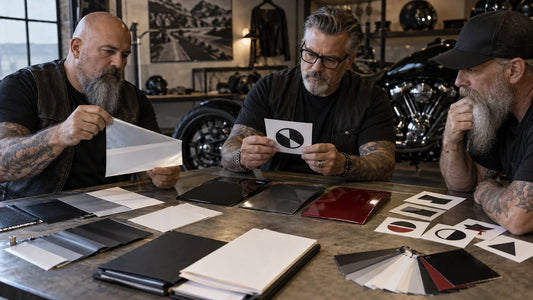
Create a privacy-safe test set: blank cards matching the required physical formats and unprinted paper cut and folded to the relevant cash format. Record the number and type of items and their priority. If a member needs quick access to one card, that requirement matters as much as the total count. Do not photograph personal names, account numbers or identification.

Map the internal pocket layout
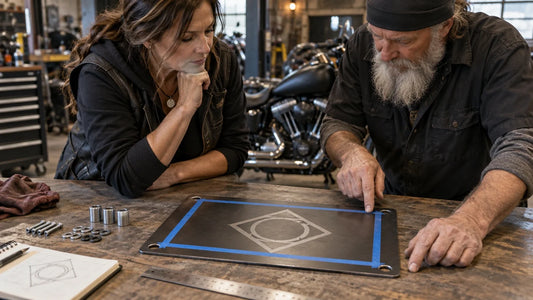
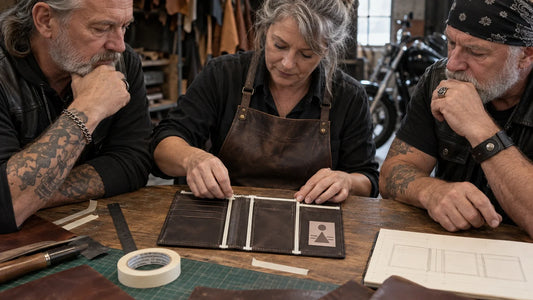
Open the offered sample and sketch the pocket orientation, openings, fold and any lining or stitch boundaries. Ask the supplier for usable internal dimensions where available. Outside width is not internal capacity: seams, pocket depth and fold allowances all consume space. Likewise, one currency or card mix does not prove that every intended mix will fit.
Include cards or paper formats only when they represent a real requirement, and avoid filling every available pocket merely to produce a maximum count. An overpacked test can hide the intended access sequence and distort the fold. If the club has two common carry patterns, document them as separate test sets and ask whether one offered layout serves both responsibly.
Load the sample and test access
- Insert the blank test contents in the intended pockets.
- Remove and replace priority items several times.
- Check that card edges do not catch on the fold or stitching.
- Close the wallet naturally without forcing or overcompressing it.
- Repeat with the largest intended contents variant.

Record open and loaded folded size
Follow the supplier's measurement method and state units. Record the wallet open, folded empty and folded with the standardized contents loaded. If thickness matters to the intended carry, record it at the agreed point without squeezing the sample. Do not substitute a competitor's dimensions or treat one measured sample as a production tolerance.

Save the approved layout record
Store the blank contents set, pocket map, open and folded measurements, sample ID, artwork revision, approver and date together. If one pocket proves inaccessible, revise the layout requirement and retest the physical sample; do not solve a capacity problem by quietly removing a required item from the test set.
On reorders, repeat the test if the supplier changes the wallet construction, pocket layout or substrate. A prior approval applies to the recorded sample, not automatically to a visually similar replacement.
Frequently asked questions
How many cards fit in a custom biker wallet?
That must be confirmed on the actual offered layout. Test the required representative contents rather than relying on outside dimensions or a generic capacity claim.
Should cash be tested flat or folded?
Use the format intended by the members and record it. Different folds change pocket use and loaded thickness.
Can one sample represent every member?
Only if the club standardizes the contents and accepts the same layout. Record exceptions as separate variants.
When should decoration be approved?
After the layout, loaded folded size and access are accepted, because decoration may depend on the resulting folds and usable exterior panel.
Ready for a layout review? Explore Wallets. Send your authorized artwork, quantities and completed measurement or sample checklist to request a design and quote review for wallets.
タグ:
以前の
Debossed, Engraved or Metal Logos on Custom Biker Wallets
次へ
How to Place a Club Logo Around Wallet Folds and Stitching
関連記事
How to Prepare a Club Decal for a Curved Surface
Sep 17 2026