
How to Choose a Club Keychain Attachment for Gloved Handling
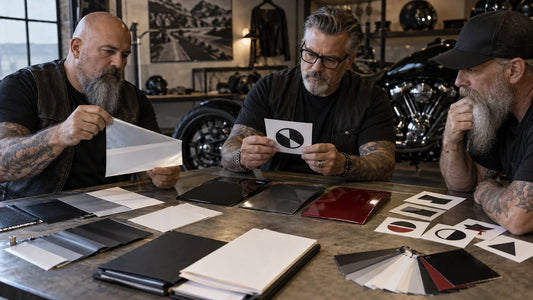
Quick answer: Choose keychain attachments for gloved handling by testing the offered split ring or clip with the intended key bundle and the actual gloves while stationary, at a stable table and off the bike. Measure the accessible opening, check how the tag hangs, and record the exact hardware and sample. Do not choose a clip from a photograph alone, and never promise that any attachment should be operated while riding.
This article owns the attachment-handling test. Material, artwork, quantity and overall procurement decisions belong in the Custom Biker Keychains buying guide.
How to choose a club keychain attachment for gloved handling
The first check is the opening members actually need to use. A split ring can hold keys securely but may require fingernail-level access. A clip may present a larger control, but its gate shape, spring, orientation and connection to the tag vary. Neither category is automatically better. Compare only hardware the supplier offers for the quoted keychain, using the keys and gloves that matter to the club.
Define the use boundary before testing: the member is stopped, the motorcycle is switched off, and the key bundle is on a table or in hand away from traffic. The test concerns ordinary off-bike handling, not access during motion.
Record ring or clip opening, intended key bundle and glove bulk
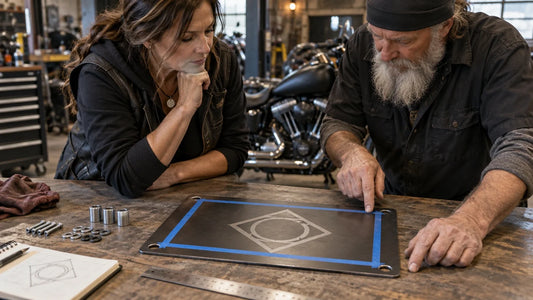
- Ring or clip opening: photograph the mechanism open and closed beside a measuring tool. Record the accessible opening with units, but leave the exact offered value pending supplier confirmation.
- Intended key bundle: count the keys, identify unusually thick heads or fobs, and check the connecting hole or loop. Hide identifying codes and addresses in any shared image.
- Glove bulk: identify the actual glove model or make a side-by-side photo showing finger thickness near the control. Do not convert that observation into a universal glove rating.
- Tag orientation: note which face should present upright and whether the hardware allows the tag or keys to twist into an awkward position.

Compare offered attachments using the actual keys
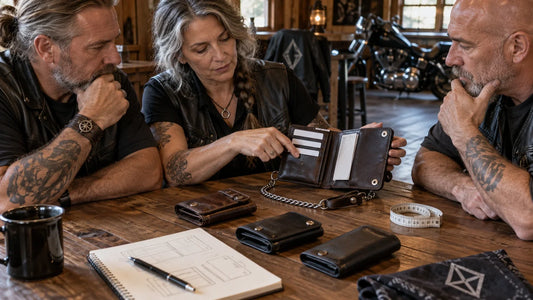
Set up a padded tray so dropped keys do not bounce or damage a sample. Test each attachment first with bare hands to understand the mechanism, then with the intended gloves. Use the same key bundle for every candidate. Record whether the member can add and remove the key safely, whether the control can be located by touch, whether the gate or ring returns to its normal position, and whether the key tag hangs as intended.
Ask more than one representative member to try the sample if glove shapes or hand sizes differ. A committee member's success does not prove universal usability. Record observations such as “completed at table with winter glove sample B” rather than “glove-friendly.” The first is evidence; the second can become an unsupported promise.

Check the result before approving the proof
- Confirm the attachment shown on the proof is the same hardware as the tested sample.
- Check the ring, clip, connector and tag orientation from front, side and reverse.
- Repeat the off-bike table test with the final sample and intended key bundle.
- Inspect whether the hardware overlaps artwork or causes the tag to present upside down.
- Ask the supplier for current dimensions, finish, available alternatives and replacement terms. Do not infer strength or durability from appearance.
A photograph may show shape and finish, but it cannot show spring feel, reachable opening or interaction with a bulky key head. If the selected attachment cannot be sampled before the group decision, mark handling as conditional rather than claiming it has been verified.
Save the approved ring or clip opening and proof version
Consider a corrected example: the committee originally chooses a compact clip from a catalog image. The real key head cannot pass through the opening, and the tag rotates backward when the keys hang. The correction is to test an offered larger-opening sample, confirm the connection geometry, rotate the tag artwork in the proof and repeat the glove test. Acceptance means the intended key bundle fits, the mechanism closes normally, the tag presents as approved and the sample identity matches the proof.

Save the ring or clip opening, intended key bundle description, glove sample, hardware/sample ID, tag orientation, artwork revision, proof version, named approver and approval date. A future reorder should reference this record but still recheck current availability and specifications.
Frequently asked questions
Is a clip always easier to use with motorcycle gloves?
No. Gate size, control shape, spring action, key bundle and glove bulk all matter. Test the offered sample with the intended setup while stationary and off the bike.
Can the club test the keychain at the motorcycle?
Keep manipulation off the bike at a stable table. Afterward, with the motorcycle parked and switched off, the club can check how the finished key bundle sits, without operating hardware while riding.
What if members use different gloves?
Test representative bulky and less-bulky pairs with the same keys, record which samples were used, and avoid a universal “glove-friendly” claim.
What must match between sample and proof?
The hardware type, finish if relevant, connection point, tag orientation, tag size and artwork version should all reconcile to one recorded approval.
Request an attachment and quote review
Send your authorized artwork, quantities and completed measurement or sample checklist to request a design and quote review for custom biker keychains.
Explore Custom Biker Keychains Read the buying guide
Test handling only while stationary and off the bike; confirm the final hardware in writing.
タグ:
以前の
How to Keep Club Names Readable on Custom Keychains
次へ
How to Keep Club Names Readable on Custom Keychains
関連記事
How to Prepare a Club Decal for a Curved Surface
Sep 17 2026