
Custom Clubhouse Rugs: Buying Guide for Club Organizers
Quick answer: A reliable custom motorcycle club rugs buying guide begins with the room, not a catalog thumbnail. Mark the intended footprint, measure clear floor space and door movement, decide what the emblem must communicate from the normal viewing position, and compare only samples the supplier currently offers. Treat pile, backing, edge, cleaning, floor compatibility, price and lead time as open until the merchant confirms them for the exact product.
A clubhouse rug is both a floor object and a large identity surface. That makes the order more demanding than sending a logo and choosing a nominal size. The committee has to reconcile people moving through the room, doors and furniture, the physical construction, artwork simplification, cleaning instructions and a traceable approval. A screen proof can organize those decisions, but it cannot prove how a rug grips a floor, wears, cleans or meets a fire standard.
This guide owns the overall purchasing workflow. Use the linked support articles for the worked floor-layout check, texture-readability check and printed-versus-tufted comparison. Every performance statement must come from current, product-specific merchant documentation rather than visual inference or a competitor listing.
Which custom rugs and carpets options fit the club’s intended use?
Start by naming the location and purpose in plain language: an entrance mat that can be lifted, a larger interior rug that frames a seating area, or a display surface beside a parked motorcycle. Then ask which constructions, sizes, edge treatments and backing options are actually offered. “Printed” and “tufted” describe broad process families, not automatic rankings. Printed construction may be proposed when tonal transitions or compact detail matters; tufted construction may be proposed when the artwork can work as larger color shapes. The supplier still has to confirm what its current samples can reproduce.
Do not use a lifestyle photo as evidence for outdoor suitability, fire behavior, slip resistance, load, abrasion life or cleaning chemistry. Record the intended use and ask the merchant to identify the applicable product, sample and documentation.
Measurements and specifications to collect before requesting a quote
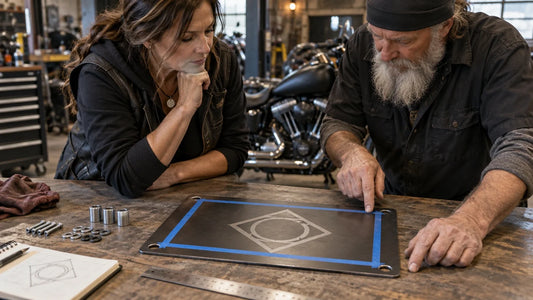
- Clear floor width and length: measure the unobstructed rectangle with units, then photograph the same area from two useful angles.
- Door swing and placement: mark every moving leaf, threshold, floor transition and nearby furniture edge.
- Walking and access routes: preserve the path people actually use; do not narrow an exit or access route to make a larger design fit.
- Surface and room conditions: identify the floor type and interior location without assuming compatibility.
- Product evidence: request the actual pile or print sample, backing view, edge detail and current cleaning instructions.

Prepare original artwork for a floor-scale application
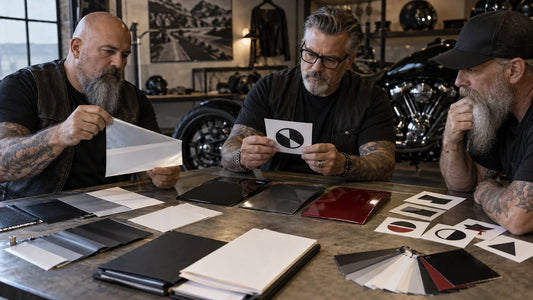
Supply the authorized master and name the person allowed to approve adaptations. Identify the emblem elements that cannot change, but allow the supplier to flag lines, gaps or color boundaries that the offered construction cannot reproduce. The proof should show the artwork inside the measured footprint at actual proportions, with an orientation tied to the room rather than an arbitrary page top.
Keep fixed artwork separate from any requested names, dates or quantity variants. If the club has no approved logo file for this inquiry, do not substitute a real club mark or copy an online patch. Use only authorized artwork; the concept imagery in this package uses a fictional, wordless road-and-horizon motif.
Compare actual materials, processes and sample options
| Decision | Evidence to compare | Keep pending |
|---|---|---|
| Printed versus tufted construction | The same authorized motif on current physical samples at the proposed scale | Reproduction limits, price and timing until confirmed |
| Removable mat versus larger rug | Marked footprint, edge profile, handling plan and current offered dimensions | Floor compatibility and performance claims without documentation |
| Backing and cleaning option | Reverse-side sample, edge detail and current written care guidance | Slip, fire, outdoor, wear or cleaning claims not supported for the exact item |

Approve the proof and sample before the group order
- Mark the proposed footprint in the room and confirm doors, furniture and access remain workable.
- Place the applicable sample in the intended light and read the emblem from the normal room position.
- Inspect the face, edge and reverse without inferring hidden composition or performance.
- Match the approved proof to the named sample, artwork revision and written specification.
- Record the selected quantity, destination, needed date, responsible contact and named approver.

Build one quote-ready club order brief
Send the floor measurements and annotated photos, intended use, floor description, authorized artwork, desired quantity and variants, destination, needed date and committee contact. Ask for the current offered dimensions, construction, pile or print sample, backing, edge, cleaning instructions and any floor-compatibility guidance. If anti-slip, fire, abrasion or outdoor performance matters, request exact-product documentation and leave the field open until it arrives.
For the detailed checks, read how to choose a rug size for the actual clubhouse floor, how to keep a club logo readable in a textured rug, and how to compare printed and tufted clubhouse rugs.
Frequently asked questions
What should a club decide before asking for a rug quote?
Confirm the actual location, clear footprint, door and access constraints, intended viewing position, authorized artwork, quantity and the evidence the supplier must provide.
Is a printed rug always better for detailed artwork?
No. Compare current physical samples using the same artwork and proposed scale. The supplier must confirm reproduction limits for the exact offered construction.
Can a photo confirm that a backing is non-slip?
No. A photograph cannot establish slip performance or floor compatibility. Request current product-specific documentation and installation guidance.
What should be saved after approval?
Retain the measured layout, room photos, sample identity, face and backing views, artwork and proof revisions, written specification, quantity, approver and date.
Request a design and quote review
Send your authorized artwork, quantities and completed order brief to request a design and quote review for custom rugs & carpets.
A design inquiry is not production approval. Confirm current specifications, quote and final proof in writing.
Tags:
Previous
Printed or Tufted Clubhouse Rugs? Match the Construction to the Artwork
Next
Printed or Tufted Clubhouse Rugs? Match the Construction to the Artwork
Related articles
How to Prepare a Club Decal for a Curved Surface
Sep 17 2026