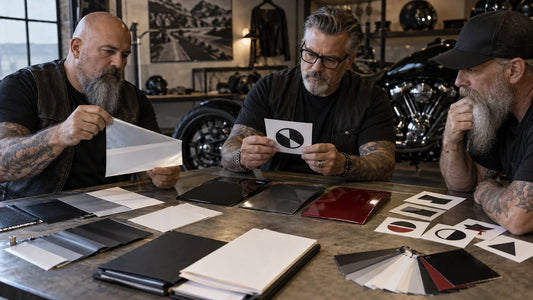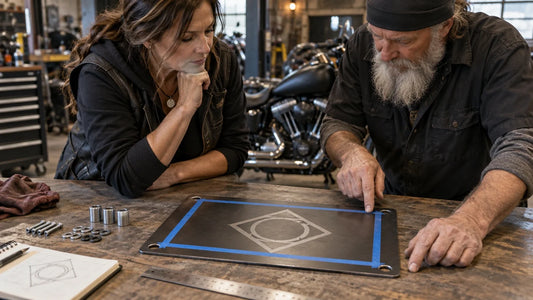

How to Keep a Club Logo Readable in a Textured Rug
Quick answer: For a club logo readability textured rug review, compare the actual sample, the smallest reproduced line or gap, and the intended viewing distance. Use the same authorized emblem across applicable materials, simplify details that disappear in texture, and approve the physical result from the normal room position. A crisp screen proof does not prove tufted detail, colorfastness, wear or cleaning performance.
A rug is not a smooth sign. Fibers, pile direction, edge transitions and viewing angle can soften a boundary that looks precise on screen. The practical goal is not to preserve every pixel; it is to preserve the hierarchy that lets a member recognize the authorized emblem in the room.
This article owns the artwork-readability check. For floor fit, construction selection and ordering steps, use the Custom Clubhouse Rugs buying guide.
How to keep a club logo readable in a textured rug
Identify the emblem’s primary silhouette, dominant divisions and essential negative spaces. Those features should survive first. Fine outlines, tiny counters, close parallel rules or small lettering may require adjustment, but the authorized approver—not the supplier or article writer—must approve identity changes. Ask the supplier to show the relevant reproduction limit on a current sample rather than accepting a generic resolution claim.
Record the pile or texture sample, minimum reproduced detail and viewing distance
- Sample identity: name or code the exact physical face, reverse and edge sample being reviewed.
- Smallest essential feature: measure the narrowest line, gap or color separation that must remain distinct, using units.
- Proposed rug scale: place the full emblem at the intended proportions and orientation.
- Viewing distance: mark the normal position from which the rug should read, without turning that observation into a universal distance rule.
- Light and angle: review in conditions representative of the room and record them as context.

Compare the emblem on actual material samples
- Use one authorized artwork revision across every applicable sample.
- Scale the emblem to the proposed physical footprint rather than changing scale between constructions.
- Inspect which lines merge, which gaps close and which color boundaries lose separation.
- Create a simplified candidate that preserves the main silhouette and negative space.
- Review both samples flat, then in the intended room position.
Do not let a close-up photograph decide the order. Close views help document construction; the normal room position shows whether the hierarchy reads. Neither view proves colorfastness, abrasion life, fire behavior, outdoor suitability or cleaning performance.

Check the result before approving the proof
Reject a proof that shows fine detail only as a smooth rendering while the physical sample is absent or unnamed. Also reject a comparison that changes both artwork and scale, because it cannot show which variable caused the difference. The corrected review uses the same sample identity, proposed scale and room orientation, with each approved simplification clearly marked in the artwork revision.
- Do not equate printed proof detail with tufted or textured detail.
- Do not claim exact color or colorfastness without relevant current evidence.
- Do not invent a universal minimum line width; ask for the supplier’s current limit and verify it on the applicable sample.
Save the approved pile or texture sample and proof version

Save the sample identity and photographs, smallest approved details with units, proposed rug dimensions, viewing position, lighting context, authorized artwork revision, proof version, named approver and date. If the supplier, construction, scale or room changes, repeat the relevant checks rather than assuming the old result transfers.
Send the completed checks for a custom-order review
Send the pile or texture sample reference, measured essential details, intended viewing position, proposed size, authorized original and simplified artwork, and quantity. Ask the merchant for current construction limits, an actual pile and backing sample, edge details, cleaning guidance and floor compatibility. Keep anti-slip, fire, wear, outdoor and colorfastness statements pending exact-product evidence.
For the full order sequence, current option questions and approval workflow, return to the Custom Clubhouse Rugs buying guide.
Frequently asked questions
Why can a rug logo look different from the proof?
A smooth screen image does not reproduce fiber texture, pile direction, physical scale, room light or viewing angle. Approve an applicable physical sample.
Which logo details should be simplified first?
Start with nonessential fine lines or tight gaps that disappear on the sample, while protecting the primary silhouette and essential negative spaces. The authorized approver controls changes.
Is there one minimum line width for every rug?
No. The applicable construction, scale and supplier process determine the limit. Request current guidance and verify it on the exact sample.
What makes a readability approval reusable?
Record the sample, size, measured details, viewing position, light context, artwork and proof revisions, approver and date. Recheck when a controlling variable changes.
Request a design and quote review
Send your authorized artwork, quantities and completed measurement or sample checklist to request a design and quote review for custom rugs & carpets.
Explore Custom Rugs & Carpets Read the buying guide
A design inquiry is not production approval. Confirm current specifications, quote and final proof in writing.
Tags:
Previous
How to Match a Club T-Shirt Print Method to the Actual Fabric
Next
How to Match a Club T-Shirt Print Method to the Actual Fabric
Related articles
How to Prepare a Club Decal for a Curved Surface
Sep 17 2026