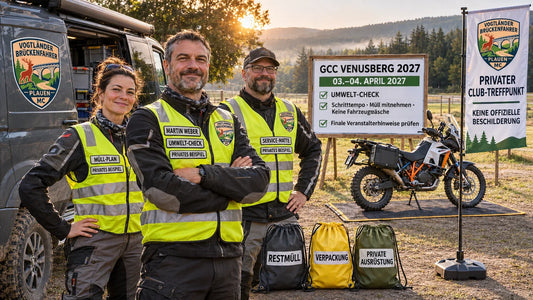
Touratech Rally West 2027 Route Plan: GPS, Skills & Club Ride Prep
Touratech Rally West 2027 runs June 24–27, 2027, near Plain, Washington. For a motorcycle club, the smartest preparation is not choosing the hardest ride on the menu. It is building a repeatable system that lets every rider select an appropriate route, load the official GPS track correctly, carry water and essential personal items, and return to a known regroup point without turning a self-guided rally day into an improvised club operation.
The official event information says Friday and Saturday are each planned to offer at least eight route options, ranging from scenic and relaxed to technical. The event FAQ explains that most routes are self-guided with provided GPS tracks, while some group rides are offered for less-experienced riders. That variety is valuable—but it also means a club should not make one route choice for everyone. This guide turns the verified event framework into a practical private-club plan without inventing unreleased 2027 track details.
Planning boundary: detailed 2027 tracks and the final daily schedule were not available when this guide was prepared. Download only files released by the organizer, confirm the current event information before departure, and never treat a club-made map, lanyard, flag, or product as an official credential or route marker.
Start with the rider, not the route name
A route label cannot evaluate a rider’s current fitness, recent off-road practice, motorcycle weight, tire condition, fuel range, comfort with exposure, or willingness to turn around. Build a private roster that records those variables without ranking members publicly. Each rider should make the final decision about whether an opportunity matches their ability and motorcycle. Club pressure is a poor substitute for self-assessment.
Use three internal readiness bands rather than pretending to reproduce the organizer’s classifications:
- Scenic-day ready: comfortable with a full riding day, navigation prompts, planned fuel stops, and ordinary unpaved surfaces appropriate to the selected route.
- Mixed-surface ready: recent practice with loose surfaces, standing control, hill starts, low-speed balance, and lifting the actual loaded motorcycle.
- Technical-day ready: demonstrated recent competence on terrain comparable to the organizer’s eventual description, plus independent recovery and navigation readiness.
These are club planning labels, not official Rally West difficulty ratings. Once the organizer releases the current route descriptions, every rider should compare those descriptions with personal capability and the motorcycle being ridden. A large adventure bike on road-focused tires may change the answer even for an experienced rider.
Build a GPS workflow before official tracks arrive
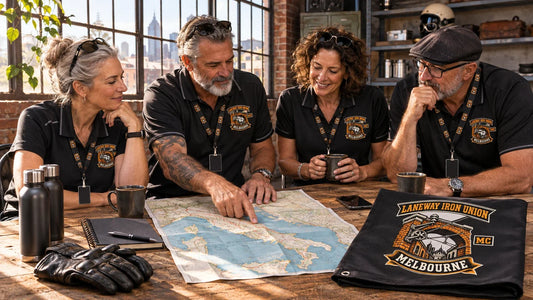
Do not create or distribute speculative GPX files. Instead, rehearse the file-handling process with a harmless local test track. Identify who will receive the organizer’s official files, where the untouched originals will be archived, and how riders will load copies onto their own devices. Preserve the original filename and file date so the club can distinguish an official release from a later personal edit.
Every rider should complete the following check on the actual navigation device, not only on a laptop:
- Confirm there is enough storage and that the device can display the expected file type.
- Load regional offline maps before traveling; cellular service should not be the navigation plan.
- Open the track at useful zoom levels and confirm it is visible, continuous, and not silently converted into a different calculated route.
- Check power cables, connectors, mounts, charging ports, spare power, screen brightness, and glove operation.
- Keep the organizer’s original file unchanged and create any personal notes in a separate copy.
- Agree that a GPS line is guidance—not permission to enter a closed road, private property, unsafe terrain, or a route changed by officials.
Before departure, designate a calm regroup rule: if a rider loses the track or the group separates, stop in a safe location, consult the current organizer information, and use the pre-briefed club contact process. Sending several riders backward without coordination multiplies risk.

Plan water and fuel from verified facts
The official FAQ says water is available onsite and tells attendees to bring a receptacle or their own water. It also says fuel is available within roughly ten miles and notes a small station in Plain. The official welcome information advises riders to fill up before 8:00 p.m. Those facts are useful planning anchors, but they are not a promise that every route fits every motorcycle’s tank range.
For each rider, record usable fuel range under the expected load—not the brochure maximum—and select a route only after the organizer publishes its current description. Begin the day with a known fuel state. If the club uses a fuel stop, name the location and the decision point in the briefing, but verify opening hours close to the event. Do not publish invented fuel waypoints.
A custom bottle can help a club identify personal hydration gear at a shared staging table. Before ordering, confirm capacity, material, lid style, mouth opening, finish, and available decoration area on the current product page. Do not assume every model is insulated, leakproof, or certified for a particular use unless that exact specification is documented.
Plan Custom Club Water Bottles
Give every rider one personal route-day bag
A compact drawstring bag is useful for items that should not disappear across a shared table: charging cable, spare eyewear, sunscreen, compact layer, personal medication, printed emergency contacts, and the rider’s own small accessories. It is not a replacement for a properly secured motorcycle luggage system, and it should not be worn where cords can interfere with riding controls or equipment.

MotorcycleClubStore’s custom drawstring bag range may include polyester, heavier polyester, cotton, or canvas constructions. Choose only after confirming fabric, cords, seam treatment, corner reinforcement, print method, internal volume, and order details for the selected model. A route-day packing list can then be sized to the real bag instead of a mockup.
Design Custom Club Drawstring Bags
Separate training registration from rally registration
The official training page states that training requires rally registration. Training is also a separate selection and expense; buying rally admission does not automatically place a rider in a class. Riders considering Level 2, Level 3, or women-focused training should read the current official prerequisites and availability, then register through the organizer’s process. Never present an old schedule or a club list as confirmation of a training place.
For club planning, put training riders in a separate column from route-day groups. Training has its own reporting time, equipment expectations, and instructor process. A rider finishing a course should not be automatically assigned a difficult club route the next morning. Fatigue and conditions still matter.
Use lanyards only for private club contact information
A club lanyard can hold a small private contact card at camp or the club’s own check-in table. It must not imitate the rally credential, claim access, display a fake staff role, or contain a copied organizer design. Keep the card visually distinct and limit it to club-controlled information that members have approved.

Common custom widths include 10, 15, 20, 25, and 30 mm, while printed polyester, dye-sublimated, woven, or nylon construction may suit different artwork. Confirm the current page options and choose hardware that matches the actual card holder. For riding, stow loose lanyards safely; they should not hang near controls or rotating parts.
Create a stationary regroup point—only where permitted
A private-club flag can help members recognize a club-controlled table or campsite, but only with organizer and venue permission. It is not a route marker, an emergency signal, an official rally sign, or a motorcycle-mounted accessory. Never place it on a road, trail junction, fence, or land the club does not control.

Custom rally flags can be horizontal, vertical, or made to a confirmed size, with construction options such as reinforced edges, eyelets, or pole sleeves. Select the mounting method only after choosing the permitted stationary location. Ask how the reverse will appear, because some printing methods show a mirrored or less-saturated reverse rather than a second independent face.
Plan a Stationary Custom Rally Flag
Prepare for recovery without promising rescue
The event FAQ says motorcycle recovery is the attendee’s responsibility and cost. It also says onsite medics are planned and a waiver is required. A club should therefore distinguish medical response from motorcycle extraction. Record emergency contacts, insurance or roadside-assistance details, motorcycle location-sharing choices, and the decision path for contacting appropriate help. Do not advertise a club “rescue team” unless it genuinely has trained people, suitable equipment, permission, and a defined operating boundary.
At the briefing, count riders at departure, planned regroup points, and final return. If someone intentionally leaves the group, record that change through the agreed contact method. If someone is missing, stop and use the plan instead of launching several uncoordinated searches.
Order gloves by construction and fit—not by logo size

Selected custom glove models may use cowhide, goatskin, or sheepskin and may offer features such as perforation, lining, or touchscreen panels. Those features vary by model. Confirm material, size method, cuff, closure, seam layout, and artwork area on the exact product. A club mark belongs on an approved back-of-hand or cuff panel—not across the palm or a high-flex joint. Custom branding does not establish impact protection or safety certification.
Explore Custom Club Leather Gloves
Treat a neck gaiter as an accessory, not PPE

A neck gaiter can provide a coordinated club accessory and selected constructions may support full-surface printing. Before ordering, confirm fabric, weight, stretch, dimensions, seam, edge finish, print method, and care instructions. Test artwork at normal wearing stretch so text and the club mark do not distort across a seam. Do not describe the item as respiratory, impact, or medical protection.
Create Custom Club Neck Gaiters
A 48-hour club readiness sequence
- 48 hours before the ride: check the organizer’s current route and schedule information; archive the official track files; confirm device loading and offline maps.
- The evening before: confirm each rider’s route choice, motorcycle, tires, fuel state, water plan, training commitments, and independent recovery information.
- At the private briefing: state the departure count, regroup method, turn-around principle, contact process, and final count location. Do not overwrite organizer instructions.
- At departure: each rider makes the final go/no-go decision. Conditions and health outrank the plan.
- At return: complete the rider count and record intentional departures before closing the club operation.
A coherent product set can support this workflow when every item has a defined job and a realistic construction. It should never manufacture authority the club does not have. MotorcycleClubStore can help translate authorized club artwork into coordinated water bottles, bags, lanyards, stationary flags, gloves, and gaiters after the club approves specifications and permitted use.
Request a Custom Club Route-Day Kit Quote
Touratech Rally West 2027 route-planning FAQ
When is Touratech Rally West 2027?
The official site lists June 24–27, 2027, with gates opening at noon Thursday and the event running through 1:00 p.m. Sunday. Verify the current organizer page before travel.
How many route options are planned?
The official welcome page says Friday and Saturday are each planned to have at least eight options, from scenic and relaxed to technical. Final route details can change and should come from the organizer.
Are the routes guided?
The official FAQ says most routes are self-guided using provided GPS tracks, with some group rides for less-experienced riders.
Should a club build its own Touratech Rally West GPX files?
No. Wait for official files, keep the originals unchanged, and do not publish speculative tracks or directions. Riders may keep private notes separately without presenting them as official information.
Is training included with rally registration?
No. The official training page says rally registration is required for training, while training is separately selected and paid. Check current prerequisites and availability directly with the organizer.
What should riders know about water, fuel, and recovery?
The FAQ says water is available onsite but attendees should bring a receptacle or their own water; fuel is available nearby, including a small station in Plain. The event information advises filling before 8:00 p.m. Motorcycle recovery remains the attendee’s responsibility and cost.
Are these custom products official Touratech Rally West merchandise?
No. The examples are private motorcycle-club products using authorized club artwork. They are not event credentials, official merchandise, organizer signage, route markers, or proof of access.
Sources and independence note
Event facts were checked against the official Touratech Rally West welcome page, official FAQ, training page, and registration page. This independent planning guide is not affiliated with, sponsored by, or endorsed by Touratech Rally West. Organizer information controls if it differs from this article.
Tags:
Previous
2027 Mildura Speedway Format Explained: 20 Heats, Semi-Finals, Scoring & Club Watch Guide
Next
Auerberg Klassik 2027: Motorradklassen, Bewerbung & Gleichmäßigkeit
Related articles

ABR Festival 2027 Test Rides & Trail Pass Guide
Nov 17 2026