
Custom Biker Patches for Vests and Jackets
Quick answer: Create a biker patch only with authorized artwork, then match its size, embroidery detail, edge and backing to the exact vest or jacket location before approving production.
At a glance

Define the patch’s job

Start with the purpose: member identification, an event, a memorial, a support message or an authorized club position. Purpose controls the information hierarchy and helps prevent a patch from implying a status the wearer does not hold. Club names, logos, colors, chapter identifiers and office titles must come from the organization that controls them. Keep written approval with the order record.
Measure the actual garment area

Lay the vest or jacket flat without stretching it. Measure the usable area between seams, vents, pockets, zippers and armor panels. Note how the garment curves on the body and how it changes when the wearer reaches forward. A paper template at actual size is more reliable than judging a large proof on a screen.
- Check clearance from structural seams and pocket openings.
- Keep important lettering away from folds and high-wear edges.
- Test the layout while standing and in a normal riding posture.
- Confirm that the planned position follows the club’s rules.
Choose construction for the artwork
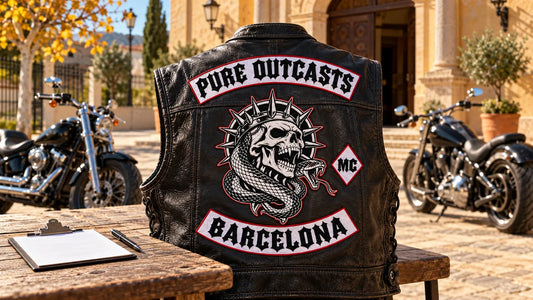
Embroidered patches suit bold shapes and lettering, but thread cannot reproduce every tiny line. Woven construction can hold finer detail with a flatter surface. Printed patches can reproduce gradients and photographic detail, although the edge, fabric and intended wear still matter. Ask the maker for the minimum line width and lettering height for the chosen method.
Merrowed borders work well on regular shapes with a suitable edge. Heat-cut or laser-cut edges allow more complex outlines. Neither is automatically better: the correct choice follows the approved silhouette and garment application.
Select a backing and attachment method
Sew-on attachment is durable and serviceable for many vests and jackets. Heat-applied backing depends on the garment material, coating and heat tolerance; it should not be assumed safe for leather, waterproof membranes or technical laminates. Hook-and-loop can work when authorized patches need to be removable, but the loop field changes the garment and must be placed accurately.
For leather, use appropriate needles, thread and technique so holes are planned rather than repeatedly corrected. For a waterproof garment, every needle hole can affect water resistance. Consult the garment maker or a qualified alteration professional when construction is uncertain.
Approve the proof at actual size
Review spelling, chapter information, colors, border shape, negative space and the relationship between every element. Print or display the proof at its final dimensions. Fine lines that look clear at 300 percent zoom may merge at production size. Record the approved version number, dimensions, colors, backing and quantity.
Inspect the sample before the full order
Compare the sample with the approved proof under neutral light. Check lettering, stitch coverage, puckering, edge consistency, loose thread, backing adhesion and overall size. Place the sample on the garment again before approving quantity production. Photograph and retain the accepted sample for future reorders.
Care after attachment
Follow both garment and patch care instructions. Avoid aggressive bleach, high heat or abrasion unless the materials are confirmed to tolerate them. Check attachment points after washing and heavy use. Repair lifting edges or broken stitches early before the patch or garment is damaged.
Ordering checklist
- Written authorization and controlled artwork
- Purpose and authorized wearer group
- Actual garment measurements and paper placement test
- Construction, border, backing and attachment method
- Actual-size proof with spelling and color approval
- Physical sample inspection and retained reorder record
Frequently asked questions
Does this guidance apply in every situation?
No. Motorcycles, products, local requirements and organization rules vary, so verify the details for the actual situation.
When is written authorization needed?
Obtain written approval before reproducing a club name, logo, colors or identity-bearing product.
Tags: