
Custom Clubhouse Metal and Tin Signs: Buying Guide for Club Organizers
Quick answer: Choose clubhouse signage by matching construction to the real wall and viewing position. Compare flat tin-style wall art with dimensional metal signs using the supplier’s actual substrate, depth, edge, coating, mounting, and display specifications. Measure the available area and viewing distance, test a full-size proof, and approve holes, safe areas, finish, and hardware before production.
This custom motorcycle club metal signs buying guide helps organizers turn an authorized emblem into a quote-ready display brief. Use the focused guides for viewing-position readability, mounting-hole planning, and flat versus dimensional construction.
Choose the format by the intended display
| Format | Useful starting point | Evidence to request |
|---|---|---|
| Flat tin-style wall art | A comparatively thin graphic panel where low projection is preferred | Actual substrate, edge treatment, print or finish, mount, and display limits |
| Dimensional metal sign | A layered or raised treatment where depth and shadow are part of the design | Materials by layer, total depth, weight, edge view, backing, and mount |
“Tin-style” describes a familiar wall-art category; it does not prove that every offered panel is made from tin. “Metal sign” also does not identify alloy, thickness, coating, or outdoor suitability. Use the current merchant specification for the exact quoted item.
Measure the wall and test the sightline
Record available width and height, normal viewing distance, intended center height, lighting direction, and nearby doors, shelving, trim, fixtures, or other signs. Photograph the wall straight on and from the normal approach. Convert the proposed layout into a full-size paper proof and view it from the real position.
Focus on the emblem’s essential shapes and any approved words. If they do not separate clearly, simplify the hierarchy, increase usable scale, or reconsider the available area. Do not rely on a universal letter-height formula; typeface, contrast, lighting, layout, and viewer conditions all matter. Clubhouse decor is not a substitute for code-required or safety signage.

Plan mounting before final artwork
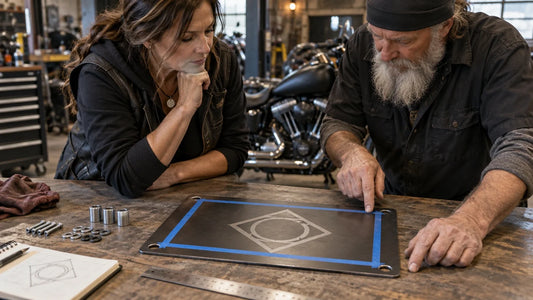
Identify the wall construction and proposed fixing method with a qualified installer or facilities lead. Ask the supplier which holes, brackets, studs, spacers, or back are included. Obtain hole locations and merchant-required edge distances where available, then keep the emblem and critical copy inside a clearly defined safe area.
Do not drill new holes through a completed sign unless the manufacturer specifically approves the method. Unplanned drilling can damage finishes, crowd artwork, create unsafe clearances, or invalidate the construction assumptions behind the quote.

Compare actual construction samples
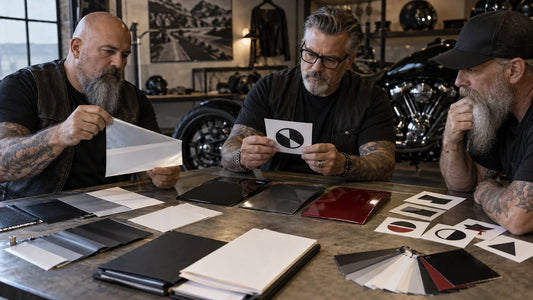
Ask for applicable samples showing front, edge, and back. Compare the same original abstract emblem when possible so depth, print, engraving, sheen, edges, and shadows can be judged without a design change. Review samples in lighting similar to the intended display and from normal viewing distance.
For any indoor, covered, or exposed location, document the environment and obtain the supplier’s current suitability and care guidance for that exact substrate, coating, assembly, and mount. Never infer exposure performance from visual style.

Build the order handoff
Provide authorized artwork and ownership confirmation; preferred flat or dimensional route; actual wall measurements and photographs; viewing distance and lighting; display environment; target dimensions; mounting method and hole requirements; quantities; destination; and needed-in-hand date. Ask for current schedules and leave time for proof and sample corrections.
Save the final dimensional proof, construction specification, sample reference, color and finish approval, mounting drawing, installer notes, quote, care guidance, approver, and date. If any specification changes, reopen the affected approval rather than carrying forward an old sign-off.
For multiple rooms or signs, create one row per location and quantity. Do not let a shared design obscure different wall sizes, sightlines, mounting surfaces, or exposure conditions.
Frequently asked questions
Is tin-style wall art always made of tin?
No. Treat it as a format description and confirm the actual substrate in the current product specification.
When is a dimensional metal sign useful?
When visible depth and shadow suit the location and the wall, projection, weight, mounting, and maintenance requirements have been confirmed.
How should a club choose sign size?
Measure the real wall and sightline, then test a full-size proof under representative lighting before approving dimensions.
Can the club add mounting holes after production?
Do not assume so. Plan holes with the supplier and qualified installer before production and follow manufacturer guidance.
What should be approved besides the front design?
Approve substrate, depth, edges, coating, mounting back, holes, safe area, display limits, care, sample, and final proof.
Prepare a coordinated sign review
Send your authorized artwork, quantities and format-specific specifications to request a coordinated design and quote review for custom clubhouse metal and tin signs.
Explore Custom Metal Signs Review Tin Signs & Wall Art
A quote request is not production approval. Confirm the exact construction, proof, sample, and mounting plan in writing.
Tags:
Previous
Flat Tin-Style Wall Art or Dimensional Metal Club Signs?
Next
Flat Tin-Style Wall Art or Dimensional Metal Club Signs?
Related articles



How to Prepare a Club Decal for a Curved Surface
Sep 17 2026