
Where Can a Club Logo Go on Gloves Without Blocking Flex?
Place a club mark only inside a manufacturer-approved, relatively flat decoration panel that stays clear of finger and knuckle flex zones, palm or grip surfaces, structural seams and the wrist closure. The correct custom glove logo placement flex areas check uses the exact glove pattern and a decorated sample—not a generic hand outline.
Where can a club logo go without blocking flex?
Ask the manufacturer to identify the offered decoration area for the exact glove model and method. A back-of-hand panel may be workable on one construction and divided by seams or stretch material on another. Do not treat a blank-looking surface as automatically printable, embossable or suitable for an attached element.

Record the zones that must remain functional
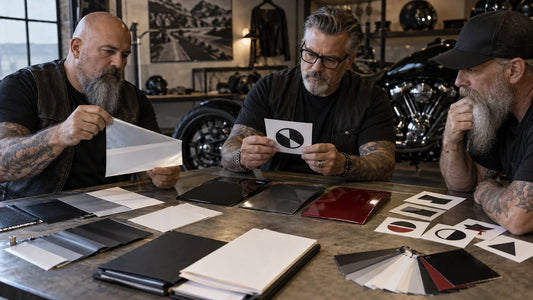
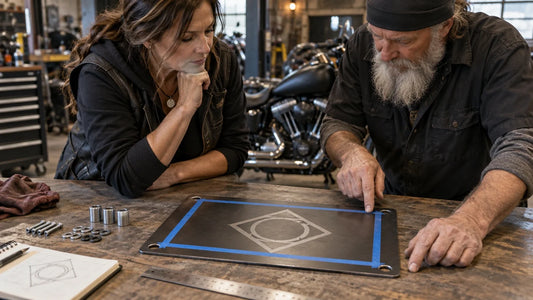
Photograph or trace the sample both back-up and palm-up. Mark finger joints, knuckle articulation, stretch or flex inserts, palm and grip areas, structural seams and the closure path. Ask the supplier to return the permitted decoration boundary with units or a production template. Keep that approved boundary with the model identifier.
When the club compares sizes, do not assume the same artwork box applies to every pattern piece. Ask whether the approved boundary changes by size and whether left- and right-hand placements are mirrored or independently positioned. Record the answer in the proof packet so production is not forced to interpret a single unlabeled mockup across the full size run.
Do not alter a seam, panel or construction feature to make an artwork concept fit. A mockup is for placement communication; it is not authority to modify the glove or a prediction of performance.
Fit the artwork to the approved panel
Use the authorized original file and reduce complexity only through the club’s named artwork approver. The proof should state finished size, orientation, color and method. Leave a supplier-confirmed margin around the approved boundary rather than pushing art to a seam or edge.

Embossing, printing and an attached piece behave differently. The manufacturer must confirm which methods are currently offered on the actual material and whether thickness, edge profile or attachment points affect the usable area. Do not describe a metal fitting as engraving, or assume that a method shown on another glove transfers to this model.
Test the exact decorated sample
Inspect the sample open and gently flexed while stationary. Check that the mark does not bridge a functional seam, buckle across a flex panel, intrude on the palm or interfere with closure operation. Compare its position and scale to the approved proof, and record the sample ID, artwork revision, reviewer and date.

Save a reusable placement record
- Exact glove model and sample ID
- Back, palm and closure reference photos
- Manufacturer-approved decoration boundary and units
- Artwork file, finished size, color, method and revision
- Seam, flex, grip and closure clearance confirmation
- Decorated-sample result, approver and date
For measurements, model selection and the complete order record, use the Custom Biker Gloves buying guide.
Frequently Asked Questions
Is the back of every glove safe to decorate?
No. “Back of hand” is not a production specification. The approved panel depends on the exact pattern, material and decoration method.
Can artwork cross a seam if the mockup looks clean?
Only if the manufacturer explicitly approves the construction and physical sample. Otherwise, keep decoration clear of structural seams.
Does a successful flex check prove protective performance?
No. It verifies the club’s fit and decoration acceptance criteria only. Protective claims require applicable documentation for the exact finished model.
Tags:
Previous
Custom Biker Gloves: Buying Guide for Club Organizers
Next
Custom Biker Gloves: Buying Guide for Club Organizers
Related articles
How to Prepare a Club Decal for a Curved Surface
Sep 17 2026